

Cycle counting: the smarter way to audit inventory
Cycle counting is an inventory auditing method where you count a small slice of stock on a regular schedule instead of shutting down to count everything at once. Operations keep running, errors surface within days, and — over a full cycle — every item still gets counted.
What is cycle counting?
Cycle counting is an inventory auditing method where you count a small subset of your stock on a recurring schedule, rather than shutting the operation down to count everything at once. Each day or week you verify a handful of items; over a full cycle, all of them get counted at least once — but the business never stops to do it.
The contrast is with the traditional annual physical inventory, where you close the doors (or pay overtime), count wall-to-wall in one exhausting push, and discover months of accumulated errors all at the same time. Cycle counting spreads that same work across the year so accuracy stays high continuously instead of spiking once a year and then decaying until the next count.
The payoff is not just less disruption. Because you count the same item several times a year, a discrepancy shows up while the cause is still fresh — you can trace it to last Tuesday’s receiving error instead of guessing which of ten thousand transactions went wrong eleven months ago. Cycle counting turns inventory accuracy from an annual event into an ongoing habit.
Cycle counting vs. physical inventory
A full physical inventory counts everything at once. It usually requires a shutdown or overtime, exhausts staff, and surfaces errors long after they happened — and accuracy degrades steadily between counts because nothing catches new mistakes until the next annual push. It is thorough, but it is a snapshot that is already going stale the moment you finish.
Cycle counting counts a portion at a time while operations continue normally. The daily workload is small and manageable, errors are caught quickly, and overall accuracy is maintained year-round because every week you are correcting a fresh batch of records. The trade-off is that it requires discipline: a count that is meant to happen every day only works if it actually happens every day.
Most businesses do not have to choose forever. Many run cycle counting as the continuous backbone and keep a lighter annual or biannual full count for financial sign-off. But if you are currently living count-to-count on one big annual event, moving the day-to-day accuracy work onto a cycle-count schedule is the single biggest upgrade you can make.
How often to count: ABC and the 80/20 rule
Not every item deserves the same counting frequency, and trying to count them all equally wastes the effort. The 80/20 rule — the observation that roughly 20% of your SKUs drive about 80% of your value — is what lets you focus. Rank items by annual consumption value (units used × unit cost), then split them into A, B, and C classes, and count each class on its own cadence.
A typical policy: A items are the top ~20% of SKUs by value and get counted most often — weekly or monthly — because a 1% error on an A item costs more than a 10% error on a C item. B items are the moderate middle (~30%) and get counted monthly or quarterly. C items are the low-value long tail (~50% of SKUs but only ~5% of value) and get counted quarterly or annually. The frequencies are conventions to tune, not laws.
This is exactly the ABC analysis you would run for any inventory-control decision — the classification is portable. If you have already tagged items A/B/C for reordering or supplier management, reuse those same tags to drive the count schedule instead of building a second system.
Cycle counting methods
ABC-based counting is the most common method: count items on a frequency set by their ABC class, so A items come up often and C items rarely. It is the best fit when the goal is to protect value — you spend your counting hours where a mistake is most expensive.
Location-based counting works through the warehouse geographically — count everything in one aisle, shelf, or zone before moving to the next. It minimizes walking and is efficient in large facilities where a counter can work a section systematically. Random-sample counting instead selects items unpredictably, which makes it good for detecting theft or fraud and for satisfying auditors who want to see that counts are not gamed.
Opportunity-based counting takes advantage of natural touchpoints: count an item when it hits zero, when you receive it, or when you pick it, so the count piggybacks on work you are already doing. Most operations combine methods — an ABC frequency policy for the schedule, location grouping for efficiency, and opportunity counts to catch items between scheduled passes.
How to implement a cycle counting program
Step 1 — classify your inventory (ABC). Sort items by annual value (units sold × cost): top 20% = A, next 30% = B, bottom 50% = C. This ranking determines counting priority and is the foundation for every later step.
Step 2 — set counting frequencies, then do the arithmetic that most guides skip. Decide the cadence per class (for example A monthly, B quarterly, C annually), then convert it to a daily or weekly workload so it is actually schedulable. The formula is simple: items to count per period = number of items in the class ÷ number of periods in its cycle. If you have 1,000 SKUs and want every item counted quarterly, that is 1,000 ÷ 12 weeks ≈ 84 items per week. If 100 of those are A items counted monthly, that is 100 ÷ ~22 workdays ≈ 5 A-items per day. Now it fits in the first 30 minutes of a shift instead of being an open-ended chore.
Step 3 — create the schedule and assign responsibility. Put the count in a fixed window (start of day, after receiving is done) and make it a named person’s job, not an afterthought; rotating counters helps because different eyes catch different problems. Step 4 — count blind (see best practices), record the result, and compare against the system quantity.
Step 5 — document and investigate every variance. Do not just overwrite the number — a discrepancy is a signal, and adjusting it silently throws the signal away. Step 6 — track your accuracy rate over time and use the trend to decide where to count more or less often. A program you review is a program that improves; one you never look back on just launders errors into the ledger.
Cycle counting best practices and accuracy
Count during quiet periods so stock is not moving mid-count — start of day, after receiving, or end of day, never while orders are being picked. Use blind counts: do not show the counter the expected quantity, so they count what is actually there instead of confirming what the system claims. When a variance is large (say over 5%), have a second person recount before you adjust, to separate a counting slip from a real discrepancy. Scan barcodes rather than eyeballing SKUs, and check every location an item can live in — main shelf, overflow, damaged-goods — because a "shortage" is often just stock in the wrong bin.
Measure inventory accuracy as a rate: accuracy = records counted correct ÷ total records counted. Most businesses target 95–99%; world-class operations run 99.5% and up. If you are below 90%, cycle counting is not optional — it is the fastest way to climb. Track the rate over time so you can see whether a change actually helped.
Above all, investigate root causes instead of just fixing numbers. Map each discrepancy to its cause and fix the process: a receiving error means the wrong quantity was booked in; a picking mistake means the wrong item or count left the shelf; unrecorded damage or returns mean stock left inventory without a transaction; a location error means the item exists but the system looks in the wrong place. Cycle counting’s real value is that it tells you which of these is happening most — so you can stop the leak, not just bail the water.
How to cycle count in StockZip
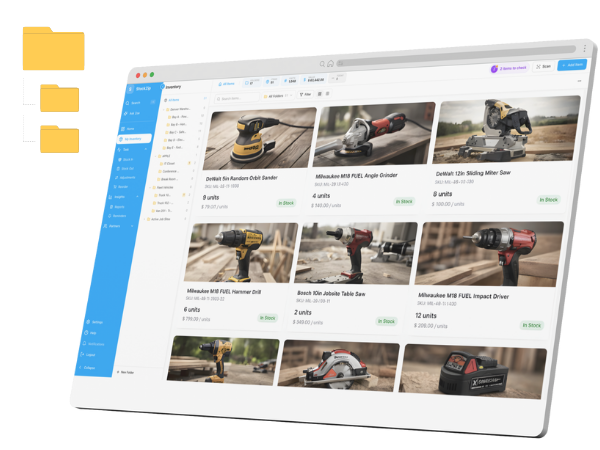
In StockZip the mechanics of a cycle count are a stock-count task plus barcode scanning: walk to the shelf, scan each item, and the app records the counted quantity against the system quantity so variances surface on the spot rather than in a spreadsheet later. Scanning is available on the Free plan, so the counting motion itself costs nothing to try. The Stock Count task that formalizes a count session into a reviewable, adjustable record is a paid feature (Starter and up).
To run an ABC schedule, tag or categorize items by class, then filter the count to a tag so A items get counted on a tighter cadence than C items without maintaining a separate workflow per tier. Low-stock alerts and per-item minimum levels are on the Free plan, so accurate counts immediately feed the replenishment side. The variance and inventory-valuation reporting that lets you watch your accuracy rate trend over time lives in reports, which are a paid feature — the Free plan does not include reports.
The honest summary: StockZip won’t design your count program for you, but it holds the ABC labels, lets you scan a filtered slice of stock on whatever cadence each class deserves, and — on a paid plan — records the variances and accuracy trend that turn cycle counting from a chore into a feedback loop.