
Bill of Materials (BOM)
A bill of materials is a structured list of every component, raw material, and sub-assembly required to manufacture or assemble one unit of a finished product.
What it means
The BOM is the bridge between sales and operations. Sales sees one SKU — say, FAN-DESK-12. Operations sees the four or five components that go into building one FAN-DESK-12. The BOM is the document that holds those two worlds together.
Every time you build one finished unit, the BOM tells the system which components to decrement and by how much. Build 100 fans, decrement 100 motors, 100 housings, 400 screws. The BOM also feeds cost roll-ups — if the components total $14.20 in raw cost, your finished good cost starts there.
Single-level vs multi-level BOM
Two flavors, and the difference is how deep the recipe goes.
A single-level BOM lists only the immediate components of the finished product. The fan's BOM might say "1 motor assembly, 1 housing, 1 grille, 4 screws." That's it. If the motor assembly itself is bought from a supplier as a complete unit, single-level is enough.
A multi-level BOM breaks down sub-assemblies into their own components. The motor assembly itself has a BOM — coil, rotor, bearings, casing, wire harness. If you manufacture the motor assembly in-house, you need that next layer visible. Multi-level BOMs are recursive — each sub-assembly is a parent to its own children.
Most furniture, electronics, and machinery operations run multi-level. Most kitting and food operations stay single-level because there's no deeper assembly to worry about.
BOM vs kitting vs recipe
These get tangled constantly.
• BOM is the structural list. The components, their quantities, their UOMs.
• Kitting is grouping finished items into a bundle without transformation. A kit has a BOM behind it, but the components stay individually identifiable.
• Recipe is the food/beverage equivalent of a BOM. A 500ml bottle of cold brew has a recipe — 80g beans, 480ml water — and that's effectively a BOM.
The line between BOM and recipe is mostly industry vocabulary. The line between BOM and kit is real: assembled goods are transformed (often irreversibly), kits aren't.
Example BOM table
A simple desk fan, FAN-DESK-12:
• 10 — MOT-12V-A, 12V DC motor. Qty 1 each. Unit cost $6.40. Extended cost $6.40.
• 20 — HSG-PLA-WH, Plastic housing. Qty 1 each. Unit cost $3.10. Extended cost $3.10.
• 30 — GRL-MTL-30, Metal grille 30cm. Qty 1 each. Unit cost $2.20. Extended cost $2.20.
• 40 — SCR-M3-12, M3 × 12mm screw. Qty 6 each. Unit cost $0.04. Extended cost $0.24.
• 50 — LBL-FAN-01, Product label. Qty 1 each. Unit cost $0.05. Extended cost $0.05.
• 60 — BOX-FAN-M, Shipping box, medium. Qty 1 each. Unit cost $0.85. Extended cost $0.85.
• Total component: $12.84.
Build one FAN-DESK-12 and your system decrements one of each of those component lines. Build 250 and it decrements 250 of each — except screws, which decrement 1,500.
How BOMs link to your inventory count
This is the part that catches people off guard. The BOM isn't decorative — it actively rewrites your stock numbers every time a build happens.
When you record "built 100 FAN-DESK-12," a properly configured system does six things in one transaction: deducts 100 motors, 100 housings, 100 grilles, 600 screws, 100 labels, and 100 boxes. Then it adds 100 finished fans to on-hand. If any component is short, the build fails or flags — better than discovering it on the line.
This also means your reorder logic for components has to know the BOM. If you've got a sales forecast of 500 fans next month, purchasing needs to see "we need 500 motors, 3,000 screws, 500 housings" — not just "we need 500 fans." That math is BOM-driven.
For a deeper walkthrough — including multi-level structures, phantom BOMs, and where they intersect with MRP — read the full guide at What is a bill of materials?.
Track it in StockZip
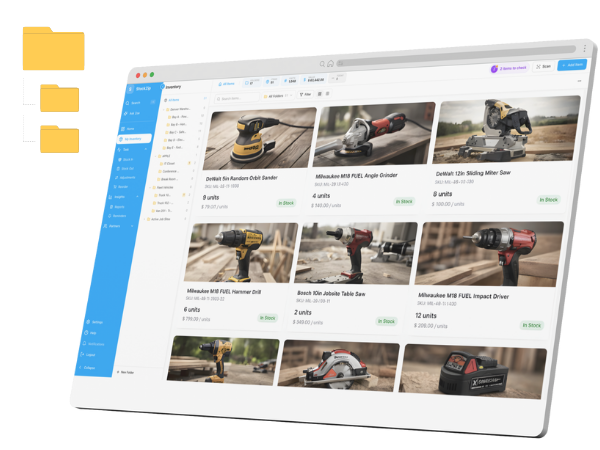
StockZip supports single-level and multi-level BOMs with automatic component decrement on every build. Define the recipe once, and every build event rewrites stock for you.
Frequently asked questions
What’s the difference between a BOM and a kit?
A BOM is a structural list — it can describe a kit, an assembled product, or a manufactured good. A kit is one specific use of a BOM, where components are grouped without being transformed. Every kit has a BOM; not every BOM is a kit.
Do small businesses need a BOM?
If you build, assemble, or kit anything from components, yes. Without a BOM, you can’t accurately decrement component stock when a build happens. Even a five-person shop assembling gift baskets is better off with a BOM than a sticky note.
What is a multi-level BOM?
A BOM where one or more components have their own BOMs. The finished product breaks down into sub-assemblies, and each sub-assembly breaks down into its own components. Useful when you manufacture intermediate parts in-house rather than buying them as complete units.
Should the BOM include labor and overhead?
A pure BOM lists materials only. Many systems let you attach labor and overhead as separate cost layers that roll up alongside the BOM — sometimes called a "cost BOM" or "manufactured cost." Keep them in distinct fields so component cost stays comparable across products.