

MOQ (Minimum Order Quantity)
MOQ (minimum order quantity) is the smallest amount of a product a supplier is willing to sell in a single order, set by the supplier to cover their setup and material costs. Orders below the MOQ are refused or repriced.
What it means
An MOQ is the supplier's floor. It's the line below which the order isn't worth their trouble. The number can be expressed in units (500 t-shirts), value ($2,000 per SKU), or weight (one pallet, 1 metric ton).
Here's a real one. A Shopify founder selling enamel pins emails a factory in Yiwu. The factory quotes $1.20/pin at an MOQ of 1,000 pieces per design. She wanted to test three designs with 200 each. The factory says no — every design needs its own mold, and 200 pieces doesn't cover the mold setup. She either commits to 3,000 pins ($3,600 plus shipping) or picks one design and orders 1,000.
That's MOQ in one paragraph. It's not arbitrary. It's the supplier protecting their setup costs.
Why suppliers enforce MOQs
Three reasons, almost always.
Setup cost. Running a production line — molds, dies, screen-printing screens, machine calibration — costs the same whether you make 100 units or 10,000. Spreading that fixed cost across more units is how the supplier hits their margin.
Material minimums. The supplier’s own raw material vendors have MOQs too. A fabric mill might only sell rolls of 500 yards. If your order uses 30 yards, the supplier is stuck with 470 yards of leftover fabric in your custom color. They push the minimum down to you.
Operational overhead. Quoting, invoicing, packing, customs paperwork, and follow-up emails take the same hours per order regardless of size. A $300 order eats the same admin time as a $30,000 order. Factories filter out small buyers with MOQs so they can focus on the orders that pay the bills.
You'll see lower MOQs from trading companies (they aggregate orders), higher MOQs direct from factories, and rock-bottom MOQs from domestic wholesalers and dropshippers — who've already paid the setup cost themselves.
MOQ vs EOQ vs reorder point
These three get mixed up all the time. They're not the same thing.
• MOQ is set by your supplier. It’s the minimum they’ll accept. You don’t control it.
• EOQ (Economic Order Quantity) is what you calculate as the most cost-efficient order size, balancing ordering cost against holding cost. EOQ is your math.
• Reorder point is the inventory level at which you trigger the next order — not the size of the order, but the timing.
In practice your real order size is max(MOQ, EOQ). If your EOQ says order 300 but the MOQ is 500, you order 500 and accept the higher holding cost.
How to negotiate a lower MOQ
You don't always have to take the quoted number. A few things that actually work:
• Pay more per unit. Offer to take 250 units at $1.50 instead of 500 at $1.20. The factory keeps roughly the same revenue with less risk.
• Combine SKUs. Three colors at 200 units each still equals 600 total units — sometimes the factory will count it as one order if the substrate is shared.
• Pay full upfront. Cash-on-deposit instead of 30/70 reduces the factory’s risk and gives them a reason to flex.
• Commit to repeat orders. A signed quarterly schedule for 12 months is worth more than one big PO. Suppliers will lower MOQ for visibility into future demand.
• Wait for off-season. Factories that are running below capacity in January will say yes to orders they’d reject in October.
Don't pretend you're a bigger buyer than you are. Factories check. Being honest about being small but reliable wins more flex than puffing up an order forecast.
Is an MOQ worth it? The buyer's math
Suppliers publish MOQ math from their side. The number that actually decides whether you accept it is your side: landed unit cost and how long the order sits on your shelf.
Landed unit cost = (unit price × MOQ + one-off tooling + freight) ÷ MOQ. Take the earlier enamel-pin quote — 1,000 pins at $1.20, a $150 mold, and $90 freight. Landed cost is (1,200 + 150 + 90) ÷ 1,000 = $1.44 per pin, not the $1.20 on the quote. The tooling and freight get cheaper per unit the more you buy, which is exactly the leverage the supplier is counting on.
Months of cover = MOQ ÷ monthly demand. If you sell 80 pins a month, 1,000 units is 12.5 months of stock. That is cash tied up on a shelf, plus the risk the design stops selling. A useful rule of thumb: if an MOQ buys more than 6–12 months of cover for a non-staple item, negotiate it down or pass — the per-unit saving rarely beats the holding cost and obsolescence risk.
So the decision is two numbers, not one: what each unit truly costs landed, and how long your cash is frozen in it.
Track it in StockZip
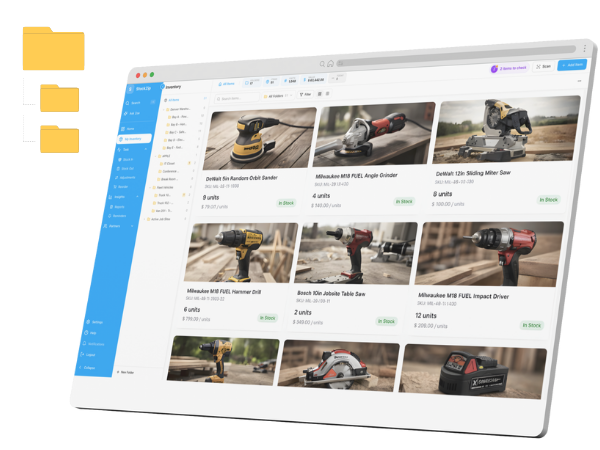
When you set a reorder point in StockZip, the system can flag if your supplier's MOQ would push you past your storage budget — so you don't accidentally commit to 500 units when you only had cash for 200. Add MOQ as a custom field on any item.
Frequently asked questions
What does MOQ mean in business?
MOQ is short for Minimum Order Quantity — the smallest amount a supplier will sell per order. It's set by the supplier, not the buyer, and it usually reflects setup costs and material minimums on the supplier's end.
How do suppliers decide on MOQs?
Mostly by working backwards from their own fixed costs — machine setup, custom tooling, raw material minimums from their vendors, and admin overhead. Once those costs are covered, profit kicks in, so they set the MOQ at the breakeven order size plus a margin.
Can I negotiate a lower MOQ?
Often, yes. Paying a higher unit price, committing to repeat orders, combining SKUs into one PO, or paying full upfront all give the supplier reasons to flex. The MOQ on the website is rarely the final number.
Is MOQ the same as EOQ?
No. MOQ is the supplier’s minimum (a constraint imposed on you). EOQ is the optimal order quantity you calculate for yourself by balancing ordering costs against holding costs. Your actual order is usually the higher of the two.