

Min/max inventory: simple replenishment that actually works
Min/max is the replenishment system most small businesses run even before they know its name: set a floor, set a ceiling, and reorder back up to the ceiling whenever you hit the floor. This guide covers the min/max formulas, a fully worked example, and when min/max beats a reorder-point-plus-EOQ system.
What is the min/max inventory method?
Min/max inventory is a replenishment method that sets two numbers per item: Min, the level that triggers a reorder, and Max, the ceiling you order back up to. When on-hand quantity drops to Min, you place an order for Max minus current on-hand — enough to refill the shelf, not a unit more or less. One pair of numbers, set once and revisited periodically, answers both questions a reorder needs answered: when to order, and how much.
That is what separates it from a reorder-point-only system. A reorder point tells you when to order but is silent on how much; most businesses that use reorder points alone answer "how much" with a fixed order quantity, a supplier case-pack, or gut feel. Min/max removes that guesswork by baking the order-up-to quantity into the same policy. That single change — pairing a floor with a ceiling — is why min/max is popular with small teams that want replenishment on autopilot without a separate order-sizing calculation.
The min/max formulas
The two levels come from data you likely already have. Min level = (average daily demand × lead time) + safety stock. Max level = Min + (average daily demand × your review or order cycle). When on-hand hits Min, the order quantity = Max − current on-hand.
Average daily demand is units sold or consumed per day, pulled from recent sales history. Lead time is the number of days from placing a purchase order to stock arriving on the shelf. Safety stock is the buffer that absorbs demand spikes and late deliveries — a term that lives inside the Min, not an optional extra. The review or order cycle is how many days of demand you want the Max to cover between reorders: weekly, biweekly, or tied to your supplier’s minimum order frequency.
A worked min/max example
Say you sell an item at an average of 15 units a day, your supplier’s lead time is 5 days, and you hold a 30-unit safety-stock buffer. Min level = (15 × 5) + 30 = 105 units. That is the trigger: when on-hand reaches 105, a reorder fires.
Now set the Max. With a 14-day review cycle, Max level = 105 + (15 × 14) = 315 units. Suppose on-hand is already at 90 units — below the 105 Min — so a reorder is due. The order quantity is the full gap back to Max: 315 − 90 = 225 units, computed the moment the trigger fires, with no separate order-quantity lookup.
Read the example as a policy, not a one-off calculation. Once the pair (105, 315) is stored on the item, every future reorder answers itself: watch for on-hand to cross 105, then order back up to 315. The arithmetic never changes until the underlying demand or lead time does — which is exactly when you should revisit the levels.
Min/max vs reorder point + EOQ
Min/max and reorder-point-plus-EOQ share the same trigger math — the reorder point and the Min level use the identical formula. They differ only in how they answer "how much to order." Reorder point plus economic order quantity (EOQ) calculates the trigger and the order size separately, optimizing order size against ordering cost and holding cost. Min/max folds the order-up-to quantity into the Max, so one policy covers both.
EOQ is worth the extra modeling once ordering and holding costs are large enough, and cleanly enough separated, to optimize precisely. Most small businesses do not have that cost data cleanly split, and a supplier case-pack or a shelf-space limit already caps the practical order size anyway. For them, min/max gets roughly 80% of the benefit with a fraction of the setup — which is why it is the default for stable-demand, small-team operations, and EOQ is the choice for cost-driven optimization at scale.
Min/max vs safety stock
A common confusion, and a frequent search, is "min/max vs safety stock" — as if you must pick one. You do not: they are not alternatives. Safety stock is a term that lives inside the Min formula. The Min is lead-time demand plus safety stock, so choosing min/max does not mean skipping safety stock, and sizing safety stock does not replace a min/max policy. Drop the safety-stock term and your Min is just lead-time demand, with no cushion for a late supplier or a busy week.
Common min/max mistakes
The first mistake is setting Max by gut instead of demand × cycle. "A round number that feels safe" is not a formula — a Max set by feel either overstocks cash into cardboard or leaves you short before the next cycle. The second is never revisiting the levels: min/max set once at launch and left alone drifts out of sync the moment demand or lead time moves, so review quarterly at minimum, and immediately after any sustained shift.
The third is applying identical rules to fast movers and slow movers. Your top sellers and your long tail do not deserve the same review cadence or the same buffer — an ABC ranking tells you which items earn tighter, more frequent min/max tuning. The fourth is ignoring safety stock in the Min calculation, which strips out the cushion that made the floor safe in the first place.
Keeping min/max levels live in StockZip
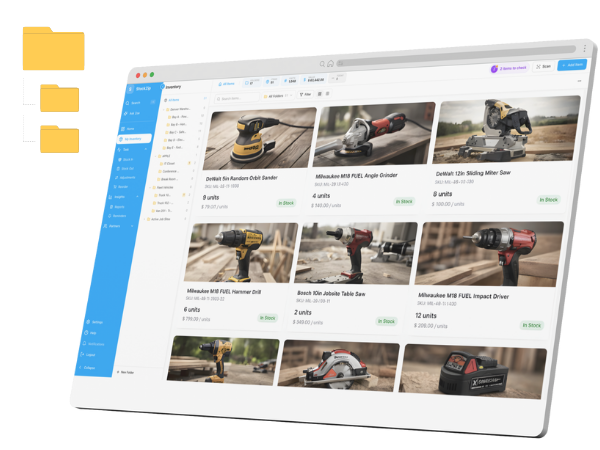
Min/max only works if the levels stay current. StockZip stores a minimum and maximum on every item and fires a low-stock alert the moment on-hand drops to the minimum — no spreadsheet to check, no manual review to remember. Both the per-item min/max fields and the low-stock alerts are available on the Free plan, so you can run a real min/max policy without paying for it.
Set the levels once from recent usage, let the alerts do the watching, and revisit the numbers when demand or lead time shifts. Pair the alerts with the reorder-point math in the related guides to keep the Min honest, and the whole loop — trigger, order-up-to quantity, and the reminder to reorder — runs off two numbers per item.