

How to set reorder points that prevent stockouts
A reorder point is the stock level at which you place a new order — early enough to survive the lead time, not so early that cash sits on the shelf. This guide covers the reorder point formula, a worked example, how much safety stock to hold, and how to turn the number into an automatic low-stock alert instead of a sticky note.
What is a reorder point?
A reorder point is the inventory level at which you should place a new order with your supplier. When stock drops to this level, you trigger a reorder so you do not run out before the next shipment arrives. It bundles two things into one number: the stock you expect to sell during the supplier’s lead time, plus a safety buffer for the days that beat the average.
The reorder point answers "when to order," which is a different question from "how much to order." How much is the reorder quantity — often an economic order quantity (EOQ) — and the two work together: when on-hand hits the reorder point, you place an order for the reorder quantity. Confusing the two is a common trip-up; this guide is about the trigger level, the "when."
Getting the reorder point right is what separates a business that quietly reorders on time from one that lurches between stockouts and panic orders. Set it too low and alerts fire too late to save the sale; set it too high and you carry cash as cardboard. The rest of this guide is the arithmetic and the habit that put the number in the right place.
The reorder point formula
The formula is simple and reliable: Reorder Point = (Average Daily Sales × Lead Time) + Safety Stock. The first term covers demand across the days you wait for replenishment; the second is the cushion for demand spikes or a late delivery. Three inputs, one number, no statistics required to start.
Average daily sales is how many units you move per day on average — pull it from a trailing few months so a single odd week does not skew it. Lead time is the number of days from placing an order to receiving usable stock, measured from your supplier’s actual performance, not their promise. Safety stock is the buffer you choose deliberately; the next two sections size it.
Because the formula is per-item, each SKU gets its own reorder point — a fast mover with a slow supplier needs a much higher trigger than a slow mover with a local one. Start with your top movers and your critical items, the products where a stockout actually hurts, and expand from there rather than trying to set a reorder point for all 500 SKUs on day one.
Reorder point worked example
Take Widget A. You sell an average of 10 units per day. Your supplier takes 7 days to deliver. You want 20 units of safety stock as a buffer against a busy week or a slow shipment. Plug those in: Reorder Point = (10 × 7) + 20 = 70 + 20 = 90 units.
So when your on-hand quantity of Widget A drops to 90, you place the order. During the 7-day lead time you will sell roughly 70 units, which lands you at your 20-unit safety buffer just as the new shipment arrives — no stockout, no scramble. If demand runs hot or the truck is late, the safety stock absorbs it; if everything lands on average, you barely dip into the buffer.
Notice what the 90 is doing: 70 units keep you selling through the wait, and 20 stand in reserve for the days that beat the average. That single chain — average demand and lead time into a trigger, plus a buffer on top — is the whole method. Change any input and the trigger moves with it, which is why the number is worth revisiting when demand or lead time shifts.
How much safety stock do you need?
Safety stock protects you from uncertainty, and a practical starting point is one to two weeks of average sales. That baseline covers most normal variation without a statistics degree; you refine it from there by item type rather than applying one number to everything.
Increase the buffer for critical items — your top sellers, seasonal products, or anything from an unreliable single-source supplier — because that is where a stockout costs a sale or a customer. Decrease it for low-value items that are easy to rush-order, have multiple suppliers, or barely dent revenue if they are briefly out; carrying heavy insurance on a cheap, easily replaced part is pure cost.
Then let experience tune it. If you are regularly stocking out, add buffer; if you always have a pile left when the order arrives, cut it. Safety stock is not a set-once figure — it is the smallest cushion that keeps stockouts below the level you can tolerate, and only your own stockout-and-dust history confirms where that sits. For the statistical service-level method, see the dedicated safety stock guide.
Turn reorder points into low-stock alerts
A reorder point is only useful if something watches it for you. The whole point is early warning, and a number in a spreadsheet you check occasionally is not early warning. The fix is to store the reorder point in your inventory system and let it fire an alert the moment stock crosses it.
Set the calculated reorder point as the minimum stock level for each key item — that threshold is what triggers alerts. Enable notifications (email or in-app) so you hear about it immediately rather than at the next manual check, and review the low-stock report on a cadence that matches your sales volume — daily for fast movers, weekly for the rest — for a consolidated view of everything that needs ordering.
Then act promptly. The system doing the watching only helps if the alert leads to an order before you run out; a reorder point that fires into an empty inbox is no better than no reorder point at all. This loop — minimum level set, alert fires, order placed — is what turns the arithmetic into a habit that actually prevents stockouts.
Common reorder point mistakes
The first mistake is setting reorder points once and forgetting them. Demand changes, suppliers change their lead times, and a trigger that was right in spring is wrong by autumn — review quarterly, or whenever you notice you are stocking out or overstocking. The second is ignoring lead-time variability: different suppliers deliver on different clocks, and padding only for demand while treating lead time as fixed leaves you exposed to the slow-shipment half of the risk.
The third is using the same safety stock for every item. A critical top-seller needs more buffer than a slow-moving accessory, so a flat buffer either starves your important items or bloats your trivial ones. The fourth is ignoring seasonality — holiday rushes and summer slowdowns move demand enough that seasonal items need their reorder points adjusted before the peak, not during it.
Underneath all four is the same discipline: a reorder point is a living number tied to real demand and real lead times, reviewed on a schedule and set per item. Treat it as a one-time calculation and it silently drifts out of date; treat it as a quarterly habit and it keeps quietly doing its job.
Reorder points in StockZip
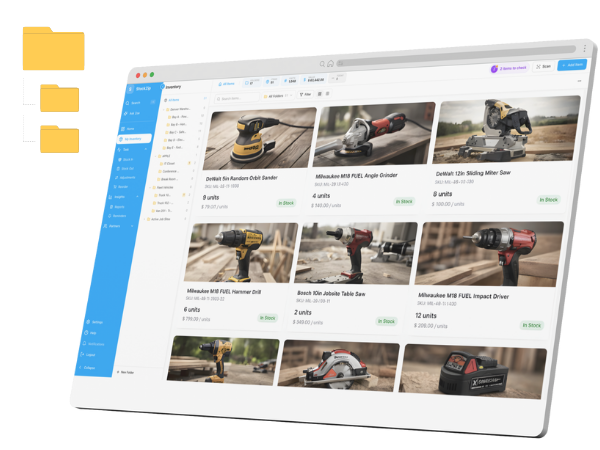
StockZip turns a reorder point into a working alert without a spreadsheet. Set each item’s calculated reorder point as its per-item minimum level, and a low-stock alert fires the moment a scan drops on-hand below it — every scan keeps the count honest, so the trigger reflects reality. Per-item minimums, low-stock alerts, and barcode scanning are all on the Free plan, so the whole reorder-point loop works without paying.
The low-stock report gives you the consolidated "what needs ordering" view in one screen, and because quantities update on every check-in and check-out, the report reflects what is actually on the shelf rather than a stale manual tally. To compute the inputs — average daily sales and lead time — the free reorder point calculator lets you plug your own numbers in and read the trigger level straight out.
The honest summary: StockZip will not pick your safety stock for you, but it stores whatever reorder point you calculate as a per-item minimum, watches it on every scan, and alerts you the instant you cross it — which is the operational half of reorder points once you have chosen the number.