
RFID inventory management vs barcode: how to choose
RFID inventory management uses radio-frequency tags to identify stock and assets without line-of-sight scanning — a whole room read in one pass. It is powerful and, for most small businesses, more system than the problem needs. This guide explains how RFID works, what it really costs on a 500-asset project, and when a barcode or QR label scanned on a phone is the smarter, cheaper choice.
What is RFID inventory management?
RFID inventory management is the practice of tracking stock and assets with radio-frequency identification tags instead of, or alongside, printed barcodes. Each tag carries a unique ID, the same way a barcode asset tag does, but the read mechanism is different: rather than pointing a scanner at one label at a time, an RFID reader broadcasts a radio signal and every tag in range answers back at once. The result is that you can inventory a shelf, a pallet, or an entire room without touching or even seeing the items.
That is also what separates RFID from barcode and QR. A barcode needs line of sight and one trigger pull per label; RFID needs neither. The practical superpower is bulk reading — an RFID handheld reads well over a hundred tags per second within its range, so a 90-minute physical count can collapse into a five-minute walk-through. That single capability is why warehouses, hospitals, and high-value asset fleets adopt it.
The practical weakness is that RFID is a system, not a product. The tags themselves are cheap. Everything around the tags — readers, antennas, middleware, and the integration that turns a raw read into a meaningful record — is not. Understanding RFID inventory management means understanding that total cost, not just the sticker price of a tag, which is exactly where most vendor pages go quiet.
How RFID asset tracking works
A complete RFID asset tracking system has four parts. Tags are stuck on the assets you care about; most are passive, meaning they have no battery and are powered momentarily by the reader’s signal. Readers emit that signal and listen for the tags’ replies — they come as handheld guns, fixed units mounted at doorways or on racks, or vehicle-mounted units on forklifts. Antennas, built into or wired to the readers, shape where the signal reaches. And middleware plus software turns "tag 837A pinged the dock reader at 09:14:22" into a real event in your asset record.
The read happens through radio waves, so orientation and environment matter in ways a camera scan does not. A tag flat against metal or behind a container of liquid can fail to answer because both reflect or absorb the signal. In an open, dry environment a passive UHF tag reads reliably at three to ten meters; crowd the space with steel racking and dense stock and that range and read rate drop. This is why a real deployment starts with a site survey, not a purchase order.
The payoff, when the environment cooperates, is hands-free and bulk. A fixed reader at a dock door logs every tagged asset that passes through without anyone scanning; a handheld sweeps a storeroom in a single pass. That is the workflow RFID is built for — and the yardstick for whether it earns its cost is whether your daily reality actually looks like that.
RFID vs barcode vs QR: when each wins
The honest comparison comes down to a handful of factors. Read distance: a 1D barcode reads at 5–60 cm, a QR code at roughly 10 cm to a meter on a phone, and passive UHF RFID at 3–10 meters. Line of sight: required for barcode and QR, not for RFID. Scan rate: one label per trigger pull or camera capture for optical codes, versus a hundred-plus tags per second for RFID. Those three rows are the entire case for RFID.
Cost is the case against it. A printed barcode or QR label costs a cent or two; a passive UHF tag costs $0.10–$0.50, and an on-metal variant $1–$3. The reader gap is wider: any phone camera reads a QR code for free, a Bluetooth barcode scanner runs $50–$400, but a dedicated RFID reader starts around $700 and climbs past $3,500 for fixed installations. RFID tags are also rewriteable and more durable, and they store a little structured data — but a QR code holds far more data and prints on anything.
The rule of thumb: if your bottleneck is "I lose track of where assets are" or "counting takes all day," RFID’s hands-free bulk reads pay off. If your bottleneck is "scanning is slow but accurate," or you have no tags at all yet, start with QR on a phone, prove the workflow, and only escalate to RFID when a specific bulk or hands-free need appears. If a team scans the same asset more than about ten times a week, RFID’s per-scan time savings start to compound; below that, the barcode amortizes faster.
Active vs passive RFID
RFID comes in two flavors across three frequency bands, with very different price tags. Passive RFID has no battery: the reader’s signal energizes the tag’s antenna, which reflects back its ID. Passive tags are cheap, durable, and maintenance-free — one can sit on a shelf for twenty years and still read — but range is limited because all the energy comes from the reader. Low frequency (125–134 kHz) reads at about 10 cm and suits animal tags and car immobilizers; high frequency (13.56 MHz) reads at 10 cm to a meter and covers access cards, library books, and NFC; ultra-high frequency (860–960 MHz) reads at 3–12 meters and is the warehouse and asset-tracking workhorse.
Active RFID has a battery, so the tag broadcasts on its own — much louder and much farther, 30 to 100-plus meters, with a battery life of three to seven years on industrial tags. Active tags cost $15–$100 each, so they are reserved for high-value moving assets like shipping containers, vehicles, or large equipment leaving a yard.
For the overwhelming majority of asset-tracking projects under 10,000 assets, the right answer is passive UHF. Active RFID solves a real-time-location problem most small businesses simply do not have, and its per-tag cost makes item-level tagging impractical. When people say "RFID inventory management" for a warehouse, they almost always mean passive UHF.
What RFID actually costs: a 500-asset breakdown
Price a real project: a small business with 500 assets across one warehouse and one office, currently tracked by spreadsheet. Option 1, a barcode baseline for comparison, is roughly $300 plus labor — about $15 for 500 in-house QR/polyester labels, ~$280 for two Bluetooth scanners, no marginal software cost on a platform you already use, and around 12.5 hours to label everything at ~90 seconds each.
Option 2, passive UHF RFID with a handheld reader, lands near $2,650–$4,150 plus labor: about $150 for 500 tags at $0.30 each, ~$1,800 for one mid-range handheld reader, $500–$2,000 for middleware or SDK integration depending on whether your platform supports RFID natively, and roughly $200 extra if a hundred of the assets are metal and need on-metal tags. Option 3, a fixed dock reader instead of a handheld, runs about $2,350–$5,650 once you add cabling, mounting, and install — and often a handheld too, for cycle counts. Every figure here is illustrative; treat it as a shape, not a quote.
The barcode option is roughly ten times cheaper to start. The RFID options pay back only under specific conditions: a weekly count that took eight hours becomes a 30-minute walk-through (a few hundred dollars a year in labor at small scale); a dock reader cuts asset shrinkage by logging everything that leaves the building (one recovered laptop can cover half the project); or a compliance regime — medical, defense, finance — requires date-stamped reads you can prove. If none of those apply, RFID is a tool looking for a problem.
When RFID is not worth it
Plain talk on where RFID does not pay. Under about 100–500 assets, the fixed reader and integration cost dominates and QR on a phone is cheaper, faster, and good enough — tags are cheap, but the hardware around them is not, and that hardware cost barely changes with fleet size. If all your assets live in one room and rarely move, RFID’s advantage is bulk reads across distance, which a single cabinet does not need.
If you have no IT or integration partner, be cautious: the reader hardware is the easy part, and the software glue between reader and asset system is where projects stall. If your read environment is hostile — heavy metal racking with no on-metal tag budget, dense liquid storage, industrial RF interference — read rates can drop below 95%, which means a human still walks the floor with a backup scanner, and you have paid for RFID while getting barcode ergonomics. And if you have no baseline metric — no honest "we lose X hours a week to counts" or "Y assets a year" — you cannot tell whether the project worked.
The reasonable middle path for most small businesses: print QR or barcode asset labels now, scan with the phones you already own, build the asset-record workflow, and revisit RFID once you cross 500–1,000 assets or hit a bulk/hands-free ceiling that optical scanning genuinely cannot clear. Start cheap, prove the workflow, escalate only when a real bottleneck demands it.
Barcode and QR in StockZip (not RFID)
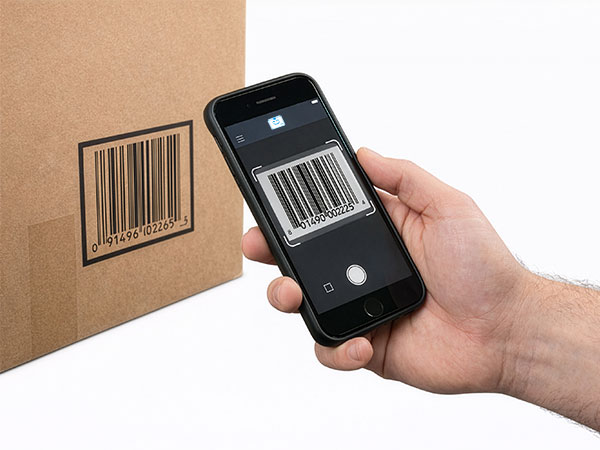
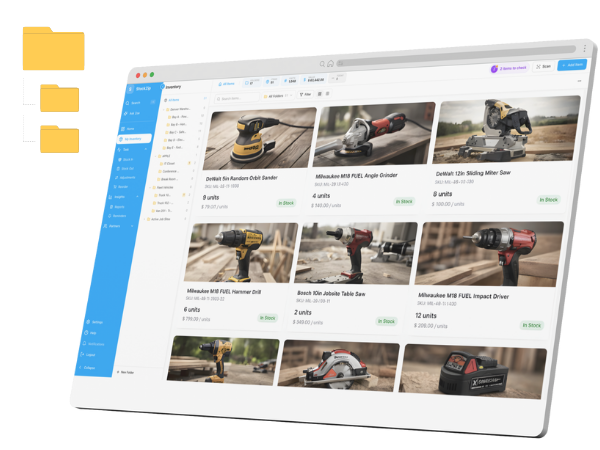
To be clear about what StockZip is and is not: StockZip is a barcode and QR inventory system, not an RFID platform. It does not include or read RFID tags, and there is no RFID reader in the product. What it does is the pragmatic default this guide keeps pointing back to — generate and print barcode or QR labels, then scan them with the phone or tablet camera your team already carries, no reader purchase and no middleware integration required. Barcode label generation and camera scanning are on the Free plan.
Every scan updates the quantity and writes a timestamped movement record, which is the audit trail an asset-tracking workflow actually runs on, and per-item minimum levels plus low-stock alerts (also Free) handle replenishment. For counting, the stock count task lets you sweep stock by folder or category — the optical equivalent of an RFID walk-through, one label at a time rather than a hundred a second.
The honest summary: if your workflow genuinely needs hands-free bulk reads across distance, RFID is the right tool and StockZip is not it. If it does not — and for most small businesses it does not yet — barcode and QR on a phone cover the same jobs at a tenth of the cost, and that is exactly what StockZip is built to do. Print labels today; escalate to RFID hardware only when a specific workflow forces the question.