
What is inventory management software?
Inventory management software tracks what you have, where it is, and how it moves — replacing spreadsheets with a live, searchable record that reorders before you run out. This guide covers what it does, the main types, who needs it, and how to choose one.
What is inventory management software?
Inventory management software is a digital system that tracks stock quantities, locations, and movements in real time. It replaces manual spreadsheets with a searchable record of every item — its counts, value, and history — and alerts you when stock runs low so you reorder before you run out.
Where a spreadsheet is a snapshot someone has to remember to update, inventory management software is a living ledger: every add, removal, move, and adjustment is written to the record the moment it happens, usually from a phone in the aisle rather than a desktop back at the office. That single change — the count updates itself as people work, instead of at the end of a shift — is what separates real inventory software from a shared file.
The category spans a wide range. At the small-business end it is a mobile, scan-first app a two-person shop can run in an afternoon; at the enterprise end it is a module inside a full ERP that ties stock to accounting, manufacturing, and procurement. What they share is the same core job: keep an accurate, current picture of what you own and where it is, so you order the right amount at the right time and never lose money to stockouts, overstock, or shrinkage you did not notice.
What inventory management software actually does
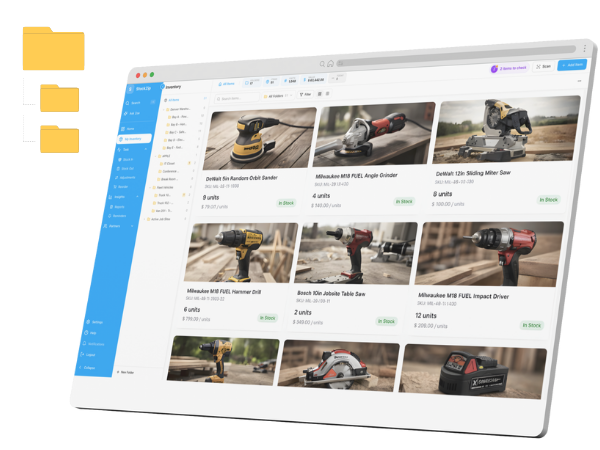
At its heart, the software answers three questions on demand: what do I have, where is it, and what has happened to it? It holds a record for every item — name, SKU, quantity, cost and price, photos, and any custom fields you need — and organizes those items into a location hierarchy so a count is always attached to a place, whether that is a warehouse, a shelf, a bin, or a service van.
On top of that record it runs the day-to-day workflow. Staff add and remove stock with quick actions or a barcode scan; the count updates instantly; and every movement is logged with a timestamp, who did it, and why — the audit trail that lets you reconstruct exactly how a discrepancy happened. When an item drops below its minimum, the system raises a low-stock alert and can suggest how much to reorder, so replenishment stops depending on someone happening to notice an empty shelf.
The last layer is reporting and control. Because the software knows quantity and cost for every item, it can value your inventory by location or category, show you what is moving and what is dead, and feed the numbers that drive purchasing and pricing decisions. In more complete systems it also runs the order chain — purchase orders in, sales orders and fulfillment out — so the same stock record that tracks a shelf also drives what you buy and what you sell.
Core capabilities to look for
Item and stock tracking is the foundation: a record per item with quantity, SKU, cost, price, photos, tags, and notes, kept current as stock moves. If the counts are not trustworthy, nothing built on top of them is either — so accurate, real-time quantity tracking is the one capability you cannot compromise on.
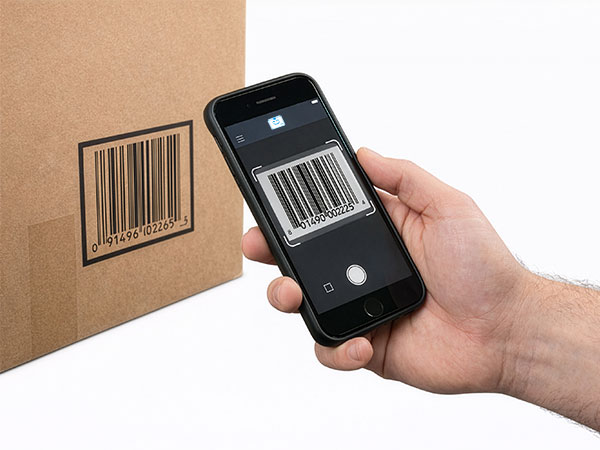
Barcode and QR scanning turn that tracking from a chore into a habit. Scanning an item to check it in, check it out, or count it is faster and far less error-prone than typing, and it is what makes a phone a viable inventory terminal. Pair it with a location hierarchy — folders or bins that mirror your real space — and you can answer "where is it" as precisely as "how many."
Low-stock alerts and reorder suggestions are what make the system proactive instead of just a record. Set a minimum (and often a maximum) per item, and the software warns you before you run out and tells you roughly how much to buy. Reporting and valuation close the loop: inventory value by location or category, movement history, and turnover reports turn the raw counts into decisions. Deeper systems add order workflows (purchase orders, sales orders, receiving, invoicing) and a full audit trail — every change attributed to a person, a time, and a reason — which is essential the moment more than one person touches stock.
Two capabilities are easy to overlook until you need them: multi-user roles (so staff can count without being able to delete items, and permissions can be scoped to a location) and import/export (CSV in to migrate your existing catalog, CSV out to move data anywhere else). Together they decide how well the tool grows with a team and how locked-in your data is.
Finally, look at how the software connects to the rest of your stack. An API and integrations let inventory data flow to your accounting, ecommerce, or purchasing tools instead of being retyped, and webhooks can trigger actions elsewhere when stock changes. Even where a live integration does not exist, CSV import and export is the universal fallback that keeps your data portable between systems. How much of this you need scales with your business — a small shop may live happily on CSV alone, while a growing operation will want its stock counts feeding its books automatically.
The three types: spreadsheet, standalone app, and ERP module
Type one is the spreadsheet. It is free, familiar, and genuinely fine for a very small catalog managed by one person — and it is where almost everyone starts. Its limits are structural, not fixable: it does not update itself, it has no real audit trail, two people editing at once overwrite each other, and there is no barcode scan, no location logic, and no low-stock alert unless you hand-build fragile formulas. A spreadsheet is a record you maintain; it is not a system that works while you are not looking.
Type two is standalone inventory management software — a purpose-built app (usually cloud-based and mobile-first) that does one job well. This is the sweet spot for most small and mid-sized businesses: it gives you real-time counts, scanning, locations, alerts, roles, and reporting without the cost, complexity, or long implementation of an enterprise suite. You can be running the same day, and the tool is designed around the actual inventory workflow rather than bolted onto accounting. The trade-off is that it focuses on inventory — if you also need deep manufacturing, general-ledger accounting, or payroll in the same system, a standalone tool integrates with those rather than replacing them.
Type three is the ERP module — inventory as one component of a large suite (NetSuite, SAP, Microsoft Dynamics, Oracle) that also runs finance, procurement, manufacturing, and HR. This is the right answer for a complex enterprise that needs every function in one database and can absorb the cost and multi-month implementation. It is usually overkill — and a slow, expensive fit — for a business whose real need is simply "know what we have and reorder on time." Choosing an ERP module to solve a standalone-app problem is one of the most common and expensive mismatches in the category.
Who needs it, and when you outgrow a spreadsheet
Any business that holds physical stock — retailers, warehouses, manufacturers, contractors, labs, nonprofits, IT teams tracking assets — is managing inventory whether or not it has software for it. The question is rarely "do we track inventory" and almost always "has our tracking method stopped keeping up." A spreadsheet quietly stops keeping up long before anyone decides to replace it.
The clearest signals that you have outgrown a spreadsheet: your catalog has grown past a few hundred SKUs and the file is slow or error-prone; more than one person needs to update stock and you keep overwriting each other; you store items in more than one location and the sheet cannot say where anything is; you are getting surprised by stockouts or sitting on overstock because nothing warns you; you need to know who changed a count and when; or you are spending real hours each month reconciling instead of running the business.
If two or more of those are true, the cost of staying on a spreadsheet is no longer zero — it is the stockouts, the write-offs, and the hours of reconciliation you are already paying, just not on an invoice. The good news is the jump is small: modern standalone tools are inexpensive (many, including StockZip, are free for a small catalog), import your existing spreadsheet by CSV, and are designed so a non-technical team can adopt them without a project plan.
How to choose inventory management software
Start from your workflow, not a feature checklist. Write down how stock actually moves through your business — how it comes in, where it lives, how it leaves, and who touches it — then look for the tool that matches that flow with the least friction. A tool that fits your workflow and does 80% of what you want beats one that does 100% but fights how your team works.
Weigh mobility and ease of use heavily. If the software is only comfortable on a desktop, it will not get used in the aisle, and inventory that is updated back at a desk drifts out of date immediately. Scan-first, phone-friendly tools get adopted; clunky ones get abandoned and quietly replaced by the spreadsheet you were trying to leave. Check that the core actions — add, remove, move, count, scan — take one or two taps.
Then pressure-test the practical realities: does it handle your number of items and locations; does it support multiple users with roles so staff can count without deleting; does it import your current catalog by CSV and export it back out so you are never locked in; and does the pricing scale sanely as you grow (watch for per-seat pricing and intro rates that jump at renewal). Finally, match the type to the need — a spreadsheet for a tiny single-person catalog, a standalone app for most small and mid-sized businesses, an ERP module only when inventory genuinely has to live inside a full finance-and-operations suite.
How it differs from a WMS, an ERP, and asset-tracking software
Inventory management software answers "what do I have and where, across my whole business." A warehouse management system (WMS) answers a narrower, deeper question: how do I run the operations inside a specific warehouse — put-away, picking paths, slotting, labor, and dock scheduling. A WMS optimizes the movement of goods within four walls; inventory software tracks the goods themselves wherever they are. A small business almost always needs the second, not the first, and many never need a dedicated WMS at all.
An ERP is the whole business system — finance, procurement, manufacturing, HR — with inventory as one module inside it. So "inventory software vs ERP" is not really a like-for-like comparison: standalone inventory software is a focused tool, while an ERP is a platform that happens to include inventory. You choose an ERP when you need every function in one database and can justify the cost and implementation; you choose standalone inventory software when the job to be done is inventory and you want it running this week, not next quarter.
Asset-tracking software is a close cousin aimed at a different noun. Inventory is stock you consume, sell, or fulfill — quantities that go up and down. Assets are durable things you own and reuse: tools, equipment, laptops, machinery, tracked by unique tag and by who has them and where, not by how many you have left. Many tools (StockZip included) handle both, because the underlying record — item, location, movement history, scan — is the same; the difference is whether you care about "how many" (inventory) or "which one, and who has it" (assets). If your real need is checking tools in and out of a crib rather than reordering consumables, weight asset-tracking capabilities accordingly.
Where StockZip fits
StockZip is standalone, scan-first inventory management software built for small and mid-sized teams — the type-two option above rather than a spreadsheet or an ERP module. The core is designed for the aisle: barcode and QR scanning, a folder and location hierarchy, photo-rich item cards, and one-tap add / remove / move, all from a phone. The free plan covers the fundamentals for a small catalog — scanning, folders, photos, low-stock alerts, and CSV import and export — with no credit card, so you can migrate a spreadsheet and see whether it fits before paying anything.
Paid plans add the operational depth a growing team needs. Starter turns on check-in/check-out, stock counts, custom fields, label printing, an audit log, and reporting; Pro adds the full order chain — purchase orders, sales orders, receiving, and invoicing — plus lot and serial tracking and API access for integrations. That maps to the capability list above: real-time tracking and scanning from day one, alerts and reporting when you outgrow eyeballing shelves, and order workflows when inventory needs to drive what you buy and sell.
The honest boundary: StockZip is inventory (and asset) software, not an ERP or a WMS. It will not run your general ledger or optimize picking paths inside a large distribution center — it integrates with the tools that do. If your need is "know exactly what we have, where it is, and reorder on time, without an enterprise project," that is precisely what it is built for. Explore the cluster guides below to go deeper on any single piece.