

Types of equipment maintenance: reactive, preventive, predictive
Equipment maintenance keeps machines and assets running safely and on schedule. The four strategies — reactive, preventive, predictive, and condition-based — trade cost, risk, and effort differently. This guide explains each, how to choose between them, and where a scan-first asset log fits versus a full CMMS.
What is equipment maintenance?
Equipment maintenance is the set of activities that keep physical assets — machines, tools, vehicles, HVAC, production lines — safe, reliable, and available for use. It spans everything from a quick lubrication or filter change to a full teardown after a breakdown, and it exists for one reason: an asset that fails unexpectedly is almost always more expensive than the maintenance that would have prevented it, once you count downtime, rushed repairs, safety risk, and lost output.
Every maintenance program is really a choice about timing — do you fix things after they break, before they break on a schedule, or exactly when the data says they are about to break? Those three answers map to the main types of equipment maintenance covered below. Most real operations run a blend: reactive on cheap, non-critical assets, preventive on the workhorses, and predictive or condition-based on the few machines whose failure would stop everything.
Two ideas underpin the whole field. First, criticality: not every asset deserves the same attention, the same way not every SKU deserves the same inventory controls. Second, maintenance history: you cannot improve what you do not record. A machine with a written log of every service, part replaced, and fault is one you can plan around; a machine with no history is one you can only react to.
Reactive maintenance (run-to-failure)
Reactive maintenance — also called run-to-failure or breakdown maintenance — means you repair an asset only after it stops working. There is no schedule and no monitoring: the machine runs until something breaks, then a technician fixes or replaces it. It is the default state of any operation that has not deliberately chosen otherwise.
The appeal is zero upfront effort and no planning overhead, which is genuinely the right call for cheap, non-critical, easily replaced items — a $15 hand tool, a light fixture, a redundant fan where a spare takes over instantly. For those, scheduling inspections would cost more than the failures.
The trap is applying it to assets that matter. Unplanned failures arrive at the worst time, force overtime and expedited-shipping premiums on spare parts, and can cascade — one seized bearing damages the shaft it was protecting. Run-to-failure also hides its true cost, because the downtime and collateral damage never show up on the maintenance line of the budget. Use it on purpose for the long tail of low-value assets, not by accident on the machines that carry your output.
Preventive maintenance (time- or usage-based)
Preventive maintenance (PM) is scheduled, routine service performed before a failure happens — on a calendar interval (every 90 days), a usage interval (every 500 operating hours or 10,000 units), or a hybrid of both. Oil changes, belt replacements, filter swaps, calibration, and inspections are classic PM tasks. The goal is to catch wear while it is cheap and predictable rather than after it becomes a breakdown.
Preventive maintenance is the backbone of most serious programs because it converts unplanned downtime into planned downtime you can slot around production. A machine you service on a Sunday morning is one that does not seize on a Wednesday afternoon. The tradeoff is that you sometimes replace parts with useful life left in them — you service on the schedule, not on the actual condition — so a rigid PM plan can overspend on parts and labor.
The practical risk with preventive maintenance is drift: intervals set once and never revisited, or a PM checklist that quietly stops being done because nobody tracks completion. This is where a maintenance history and a spare-parts stock matter — you need to know each asset is due, that the right filter or belt is on the shelf, and that last quarter’s service actually happened. A missed PM is invisible until it becomes a breakdown.
Predictive maintenance (condition data + forecasting)
Predictive maintenance (PdM) uses sensor data and analysis to forecast when a specific asset will fail, so you service it just before that point — not on a fixed calendar, and not after it breaks. Vibration analysis on rotating equipment, thermal imaging on electrical panels, oil analysis on gearboxes, and ultrasonic testing on bearings are common techniques. Instead of "every 500 hours," predictive maintenance says "this bearing’s vibration signature says it has roughly three weeks left."
The payoff is the best of both worlds: you avoid the surprise failures of run-to-failure and the wasted part life of rigid preventive schedules, because you act on the asset’s actual trajectory. For high-value, high-criticality machines, predictive maintenance often pays for itself by preventing a single catastrophic failure.
The cost is real, though: sensors, data infrastructure, and the expertise to interpret the signals. Predictive maintenance is worth it on the handful of assets whose failure is expensive or dangerous, and overkill on a drill press you could replace from stock in an hour. It is a targeted tool, not a default. Most teams reserve it for the few machines that a decision framework (below) flags as both critical and possible to instrument.
Condition-based maintenance and reliability-centered maintenance
Condition-based maintenance (CBM) triggers service off a measured condition crossing a threshold — a temperature, pressure, flow rate, or wear indicator hitting a set limit — rather than off a forecast or a calendar. It sits close to predictive maintenance, and the terms overlap in practice; the useful distinction is that CBM reacts to a present measurement crossing a line, while predictive maintenance models a future failure date from trends. A pump serviced the moment its outlet pressure drops below spec is condition-based.
Reliability-centered maintenance (RCM) is not a fifth technique but a method for choosing among the four above, asset by asset. RCM analyzes how each asset can fail, what the consequences are, and which maintenance strategy best mitigates the most likely and most damaging failure modes — accepting run-to-failure where consequences are trivial and demanding predictive monitoring where they are severe. Think of RCM as the formal version of the decision framework in the next section.
For most small and mid-sized operations, condition-based maintenance shows up in a lightweight form long before any sensor network: an operator noticing a machine is running hot, louder, or slower and flagging it. Capturing those observations — as a note or a photo attached to the asset’s record — is a poor-but-real substitute for instrumentation, and it is exactly the kind of maintenance history a simple asset log is good at holding.
How to choose a maintenance strategy for each asset
You do not pick one type of equipment maintenance for the whole operation — you pick one per asset, using two questions. First: how critical is this asset? If it fails, does everything stop, does a safety risk appear, or is it a shrug and a quick swap? Second: how predictable is its failure? Does it wear gradually in a way you can measure, or does it fail suddenly with no warning?
Those two questions give a simple grid. Low criticality, any failure pattern: run it to failure and keep a spare on the shelf — scheduling anything would cost more than the failures. High criticality but sudden, hard-to-measure failure: lean on preventive maintenance, servicing on conservative intervals because you cannot see the failure coming. High criticality and gradual, measurable wear: this is where predictive or condition-based maintenance earns its cost, because you can watch the asset approach failure and act just in time.
A worked example: a bakery with 30 machines might run its mixers and racks (cheap, quick to replace) to failure, put its ovens and proofers (critical, wear predictably) on a strict preventive schedule with logged 90-day services, and instrument only its single spiral freezer (critical, expensive, and prone to compressor failure) with temperature and runtime monitoring for condition-based service. Three strategies, chosen by criticality and predictability — not one policy forced across all 30. Revisit the grid whenever an asset’s role changes; a backup machine promoted to primary duty may deserve a stricter strategy than it had.
The asset register and spare-parts stock behind any strategy
Every maintenance strategy depends on two records that are pure inventory-management problems, not maintenance-scheduling problems. The first is an asset register: a complete list of what you own, where it is, its make, model, serial number, purchase date, and photos — so a technician arriving at a fault knows exactly what they are looking at and which manual applies. Assets without a register are assets you rediscover during every audit.
The second is spare-parts stock. Preventive and predictive maintenance both assume the right belt, filter, seal, or bearing is on the shelf when the service is due; a perfect PM schedule is useless if the part is on backorder. That means minimum stock levels and low-stock alerts on your critical spares — the same reorder-point thinking you would apply to any inventory, applied to the parts that keep your machines running. Scanning a barcode or QR code on the bin to record a part used, and getting an alert before you run out, is the unglamorous half of maintenance that keeps the scheduled half honest.
This is the seam where a general inventory tool does real work for a maintenance program, and where it stops. Holding the asset register, the part stock, the photos, and the maintenance-history notes is an inventory job. Generating and dispatching the recurring work orders, assigning them to technicians, and tracking labor hours is a maintenance-scheduling job — a different category of software, covered next.
Where StockZip fits (and where a CMMS does not)
StockZip is not a CMMS (computerized maintenance management system) or an EAM (enterprise asset management) platform, and this guide should say so plainly. It does not generate recurring preventive-maintenance work orders, assign jobs to technicians, track labor hours, or run a PM calendar. If your program needs scheduled, dispatched, and signed-off work orders, that is exactly what a dedicated CMMS category tool (UpKeep, Fiix, Limble, MaintainX, and similar) is built for — use one.
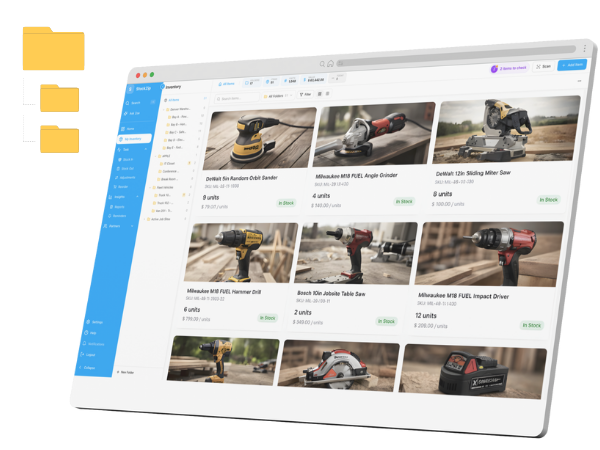
What StockZip is is the lightweight asset and spare-parts log that sits under, or instead of, a CMMS for a smaller operation. Folders and locations hold an asset register organized by site, room, or line; every item carries a photo, make/model, and notes; and barcode or QR scanning makes it fast to find an asset or record a spare part used. Per-item minimum levels and low-stock alerts keep your critical spares on the shelf before a scheduled service needs them — and scanning, folders, photos, low-stock alerts, and CSV import/export are all on the Free plan.
A few maintenance-relevant conveniences sit on paid tiers, and it is worth being exact: printing barcode or QR labels for your assets and bins, custom fields (to record next-service-due dates or asset condition), the full audit log, and inventory valuation and movement reports are Starter-plan features, not Free. Lot and serial tracking, useful for parts with batch or serial traceability, are Pro. The honest summary: StockZip will hold your asset register, your spare-parts stock, and your maintenance notes and photos, and alert you before a critical part runs out — but it will not schedule your maintenance for you. Pair it with a CMMS for the work-order side, or use it on its own if a written schedule plus a reliable parts log is all your operation needs.