
Warehousing and inventory management: how they work together
Warehousing and inventory management are two halves of one job. Warehousing is about physical space and movement; inventory management is about the numbers — what you hold, what it is worth, and when to reorder. This guide shows how they interlock across receiving, putaway, picking, and shipping, and what a small warehouse actually needs to run both.
Warehousing vs inventory management: the difference
Warehousing and inventory management are often used interchangeably, but they answer different questions. Warehousing is about the physical building and what happens inside it — where stock is stored, how it moves from the dock to a shelf to a packing bench, how space is laid out, and how goods are handled safely. Inventory management is about the stock itself as data — how many units you hold, what they cost and are worth, when each item hits its reorder point, and how accurate your recorded quantities are.
Put simply: warehousing manages the space and the movement; inventory management manages the numbers and the decisions. A warehouse can be immaculately organized and still lose money if its inventory management is blind to what is overstocked or about to run out. And perfect inventory numbers are useless if the physical warehouse is so chaotic that pickers cannot find the stock those numbers describe. The two only deliver value together.
The reason the distinction matters is that they are often different tools and even different teams. Larger operations run a warehouse management system (WMS) for the physical side and an inventory or ERP module for the numbers, and the pain is usually in the seam between them. For a small operation, one mobile inventory app can cover most of both — but only if you understand what each half is actually responsible for, which is what the rest of this guide maps out.
How the two interlock: one unit through the flow
The clearest way to see how warehousing and inventory management interlock is to follow a single unit of stock through a warehouse from arrival to departure. At every step, the physical action (warehousing) and the data action (inventory management) happen together — and a break in either one causes the same visible problem: a stockout, a lost item, or a shipment that cannot go out.
The flow has five stages: receiving (goods arrive and are checked in), putaway (they are moved to a storage location), storage and slotting (they wait in an organized spot), picking (they are pulled for an order), and packing and shipping (they leave). Warehousing owns the movement and space at each stage; inventory management owns the count and status. The next sections walk each stage, and the pattern to watch for is that the data must update the moment the physical thing moves — the instant those two fall out of sync is the instant your inventory numbers start lying.
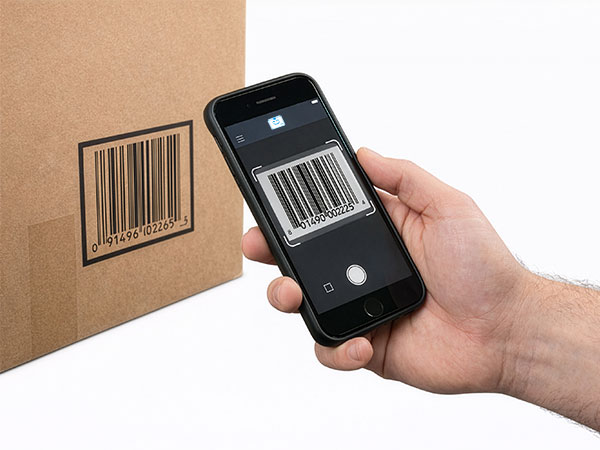
This flow is also why a barcode or QR system pays off so quickly in a warehouse: a scan is the cheapest way to keep the physical action and the data action in lockstep. Every stage below is a place where a scan replaces a handwritten note and a chance to get the count wrong.
Receiving and putaway
Receiving is where warehousing and inventory management first meet. Physically, goods come off a truck and someone checks the delivery against the purchase order — right items, right quantities, no damage. As a data action, those units are checked into inventory: recorded, counted, and their cost captured. Getting receiving right is disproportionately important, because an error here — a miscount, an unrecorded delivery — poisons every number downstream. Many stockouts trace back to stock that physically arrived but was never checked in.
Putaway is moving received goods from the dock to a storage location. The warehousing decision is where to put it — near the packing bench if it ships often, deeper in the racks if it is slow-moving. The inventory-management action is recording that location, so the number in the system knows not just how many you have but where. A unit with a quantity but no location is a unit your pickers will hunt for.
For a small warehouse, the discipline that matters most is: nothing gets put away until it is checked in, and the location is recorded as it is placed. Scanning the item and then the shelf label at putaway takes seconds and means your inventory always knows where its stock lives. Skip it, and you rebuild that knowledge from memory every time something needs finding.
Storage and slotting
Slotting is deciding where each item lives in the warehouse, and it is where warehousing borrows directly from an inventory-management technique. The principle: fast-moving, high-value items — your A items from ABC analysis — belong in the most accessible locations, at waist height, close to the packing area, so pickers spend the least time and travel on the stock they touch most. Slow-moving C items can go up high or deep in the racks. Good slotting can cut picking time dramatically without any new equipment.
Storage also enforces the physical side of stock rotation. FIFO or FEFO — first in or first expired, first out — only works if the warehouse is arranged so the oldest stock is the easiest to reach, which is a slotting and shelving decision as much as a policy. A perishables warehouse that stacks new stock in front of old is guaranteeing spoilage no matter what the inventory system says.
For a small operation, formal slotting optimization is overkill, but the core idea is free to apply: put what you pick most where it is easiest to reach, group related items, and label every location clearly so the recorded location and the physical shelf always agree. Locations that exist in the system but not on the shelf (or vice versa) are the quiet cause of most "we have it but can’t find it" losses.
Picking, packing, and shipping
Picking is pulling items from their locations to fulfill an order, and it is typically the most labor-intensive activity in a warehouse. The warehousing side is the route — which locations, in what order, to minimize travel. The inventory-management side is decrementing each item’s count as it is picked, so on-hand numbers stay accurate in real time. A pick list — a document telling the picker exactly what to pull and from where — is the tool that ties the two together.
Packing and shipping close the loop. Physically, items are boxed, labeled, and handed to a carrier; as data, the stock officially leaves inventory and, in a fuller system, the order is marked fulfilled. The critical discipline is that the count must drop when the goods leave, not a day later in a batch — because the window between a physical shipment and its recorded decrement is exactly when you oversell stock you no longer have.
For a small warehouse without a full WMS, the realistic version is a printed or on-screen pick list and a scan-to-pick habit: scan each item as you pull it so the count updates as you go. It is not wave picking or automated routing, but it delivers the thing that matters — physical movement and recorded numbers staying in sync through the busiest, most error-prone stage.
Keeping counts accurate: cycle counting
No matter how disciplined receiving and picking are, physical stock and recorded stock drift apart over time — miscounts, unrecorded movements, damage, and shrinkage all add up. The technique that keeps warehousing and inventory management honest is cycle counting: counting a small slice of the warehouse on a rolling schedule instead of shutting down once a year for a full physical count.
Cycle counting fits the warehouse flow naturally because you can count by location or by ABC class — sweep one aisle this week, count your high-value A items monthly and the long tail annually. A discrepancy caught in a weekly count can be traced to that week’s receiving and picking activity; one caught in an annual count is a year-deep mystery. Accurate counts are what make every downstream decision — reorder points, order promises, valuation — trustworthy.
This is the point where inventory accuracy and physical organization reinforce each other: a well-slotted, clearly labeled warehouse is far faster and more accurate to cycle count than a chaotic one. Investing in clear locations pays off twice — once in picking speed, once in counting accuracy.
The stack a small warehouse actually needs
Most guides on this topic assume a large operation reaching for a WMS, automated storage, and an ERP. A one-to-three-person warehouse does not need any of that to run warehousing and inventory management well — it needs four things, in order. First, clearly labeled locations: every shelf, bin, and zone named and marked, so recorded and physical locations always agree. This costs a label maker and an afternoon and prevents more losses than any software.
Second, a barcode or QR system so every movement — receiving, putaway, picking — is a scan rather than a handwritten note. Third, a single inventory app that holds items, quantities, locations, photos, and per-item minimum levels with low-stock alerts, so the numbers stay live and reordering stops being reactive. Fourth, a cycle-counting habit to catch drift before it becomes a stockout. That stack covers the physical and the data halves for a small operation at a fraction of a WMS’s cost and complexity.
The signal that you have outgrown this stack and genuinely need a WMS is specific: when picking routes, slotting optimization, wave picking, labor tracking, or multi-carrier dock scheduling become daily bottlenecks a mobile app cannot address. Below that threshold — which most small warehouses sit under for years — a disciplined barcode-and-app setup does the job. Reaching for a WMS too early buys complexity you will pay for and not use.
Where StockZip fits (and where a WMS takes over)
StockZip is a mobile inventory app, not a warehouse management system, and the distinction is the honest core of this guide. It does not optimize picking routes, run wave or zone picking, model slotting, or schedule dock doors and carriers. If those physical-warehousing problems are your daily bottleneck, that is what a dedicated WMS is built for, and you should use one.
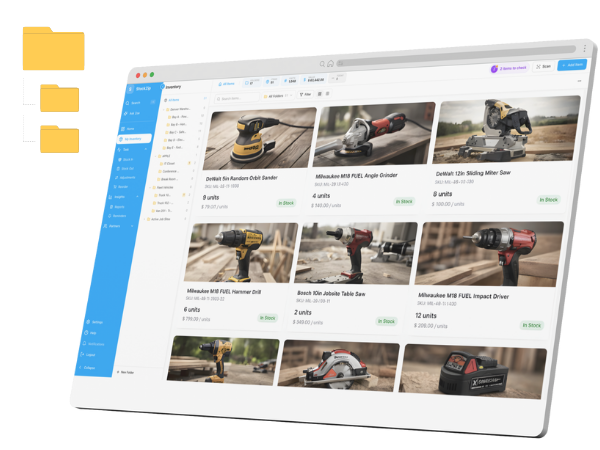
What StockZip covers is the inventory-management half of the flow plus the lightweight warehousing that a small operation needs. Folders act as locations — sites, rooms, aisles, bins — so every item’s place is recorded; barcode and QR scanning keeps receiving, putaway, and picking counts in lockstep with physical movement; per-item minimum levels and low-stock alerts make reordering proactive; and item photos help staff identify stock fast. Scanning, folders as locations, photos, low-stock alerts, and CSV import/export are all on the Free plan — the core of a small-warehouse stack at no cost.
A few warehouse-relevant features sit on paid tiers, and it is worth being exact. The stock-count task for cycle counting, inventory valuation and movement reports, custom fields, and label printing (for your location and item labels) are Starter-plan features. Pick lists — the pick-and-ship document — are a Pro feature. The honest summary: StockZip runs the numbers, locations, scanning, and reorder alerts a small warehouse needs, and prints the labels and pick lists on paid tiers — but the moment you need true warehouse-management muscle like route optimization or dock scheduling, that is a WMS’s job, not StockZip’s.