
7 inventory management tools compared by real use-case — photo catalogs, order volume, manufacturing, scan-first mobile — one honest limitation each.
How to read this list
The best inventory management software is not a single winner — it is whichever tool matches how your stock actually moves. A photo-heavy prop house, a wholesale distributor pushing purchase orders all day, and a two-person shop scanning boxes on a phone need genuinely different products, and a ranked leaderboard that pretends one tool wins for all of them is worse than useless. So this is a use-case roundup: seven real tools, each with the job it is genuinely best at and a limitation we would want to know before paying.
We include our own product, StockZip, and we hold it to the same standard — a named niche and a named limitation, not a rigged top spot. Where we quote a price it is a published rate as of July 2026, directional rather than precise, because vendor pricing changes and per-seat and per-order add-ons move the real number. Re-check the vendor’s pricing page before you commit; treat every figure here as a starting point, not a quote.
Five criteria separate a tool you keep from one your team quietly abandons. One: how fast is day-to-day capture — barcode or QR scanning from a phone, or slow manual entry? Two: how does pricing scale — flat tiers with a bundled user allowance, or per-seat and per-order metering that climbs with your headcount and volume? Three: does it fit your workflow shape — plain item tracking, order-centric purchasing and sales, or full manufacturing with bills of materials? Four: can you get your data out — real CSV export, no lock-in? Five: does it renew at the price you signed up for, or does an intro discount expire? Score any tool on those five before the feature list seduces you.
One more practical rule before the list: test with real stock, not a demo dataset. Most tools here offer a free tier or a trial, and the only reliable way to know whether your team will adopt something is to run a genuine day of receiving, counting, and searching in it — with your actual SKUs, your actual folders, and the phones your staff already carry. A tool that feels great in a polished sales demo can fall apart the moment a warehouse hand tries to scan forty boxes in a cold aisle. Adoption, not the feature matrix, is what determines whether inventory software pays off.
Sortly — best for photo-first visual catalogs
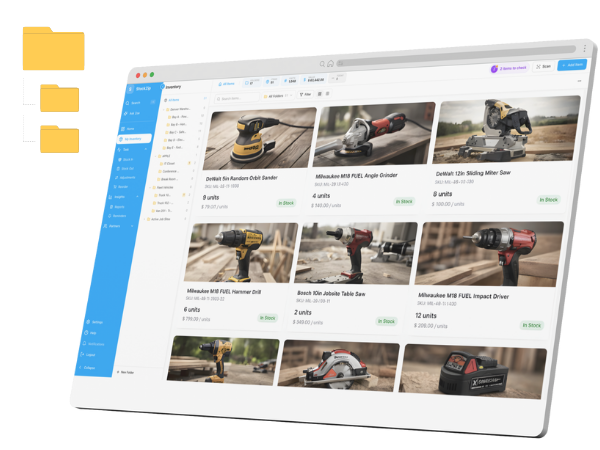
Sortly is the polished, photo-centric option, and it is genuinely good at what it does. Every item gets a picture, items nest into visual folders, and the mobile app is clean enough that non-technical staff pick it up in minutes. For equipment libraries, prop and set inventories, field-service vans, and any catalog where a photo of the item matters more than a barcode scan, Sortly is a strong default and one of the most recognizable names in the category.
The trade-off is pricing that steps up as you grow. As of July 2026, Sortly’s published rates run from a free plan to Advanced at $49/month billed monthly (or $24/month billed annually) and Ultra at $149/month billed monthly (or $74/month annually) — but the annual rates are a first-year promotional price. Sortly’s published discount is 50% off year one, then 20% off after, so the plan you buy at a headline rate renews higher in year two. That is standard SaaS discounting, not a trick, but it means you should price your second year, not your first. If you want the photo-first experience without the renewal step-up, that is the specific gap StockZip and others target.
Zoho Inventory — best for order-volume ecommerce sellers
Zoho Inventory is order-centric and sits inside the broader Zoho ecosystem, which is its real strength. If you already run Zoho Books, CRM, or the wider Zoho One suite, Inventory slots in with shared contacts, accounting, and automation, and it handles sales orders, purchase orders, multi-channel listings, and shipping integrations well. For an online seller whose day is measured in orders shipped rather than items catalogued, it is a capable, well-supported pick.
The catch is that Zoho tiers by monthly order volume, not by item count. As of July 2026 its published plans run from a free tier capped at 50 orders per month up through Standard, Premium, Plus, and Enterprise, with extra users and warehouses billed above each plan’s built-in allowance. That means a busy season can bump you into the next tier, and the sticker price is a floor rather than a ceiling for a high-volume team. It is also most rewarding once you are committed to the Zoho ecosystem — as a standalone tool it is less obviously the right call than it is as one piece of a Zoho stack.
inFlow — best for wholesale and B2B with built-in purchasing
inFlow is a heavier, order-and-purchasing suite aimed at wholesale, distribution, and light manufacturing. It brings a genuine B2B toolkit — purchase orders, sales orders, a B2B showroom for customers to order from, barcode workflows, and reorder automation — in one package. For a wholesaler or distributor who needs the whole buy-store-sell chain rather than just a catalog, inFlow is purpose-built and does not require stitching together add-ons.
That capability comes at a higher entry price. As of July 2026, inFlow’s published plans start at Entrepreneur around $129/month billed annually and climb through Small Business and Mid-Size tiers into the several-hundred-per-month range, with an Enterprise tier on custom pricing. The entry price sits roughly where lighter tools’ mid tiers do, which is the honest signal: inFlow is the right tool when you need its depth, and overkill (and overpriced) when you mostly need to track and count stock. If purchasing and B2B ordering are not central to your day, you are paying for a suite you will not fully use.
Fishbowl — best for QuickBooks-tethered manufacturing
Fishbowl is a long-established inventory and manufacturing platform best known for its tight QuickBooks integration. It handles manufacturing work orders, bills of materials, multi-location inventory, and order management, and it has a large installed base among small-to-mid manufacturers and wholesalers who run their books in QuickBooks and want inventory that syncs to them. If that describes you, Fishbowl is a serious, well-supported option with real manufacturing depth.
The limitations are cost and weight. Fishbowl is quote-based rather than transparently self-serve, and it lands as a substantial upfront and ongoing investment — this is enterprise-adjacent software with an implementation curve, not something a two-person shop spins up over a weekend. It also carries a reputation for a heavier, more dated desktop-era experience than newer cloud-native tools. For a manufacturer already living in QuickBooks it earns its keep; for a small team that just needs fast mobile stock tracking, it is far more system than the job requires.
Cin7 — best for multichannel and omnichannel at scale
Cin7 is an inventory and order-management platform built for brands selling across many channels — their own store, marketplaces, wholesale, and retail — with a deep integration catalog, built-in EDI, and 3PL connectivity. For a growing product brand that needs one source of truth across Shopify, Amazon, wholesale accounts, and multiple warehouses, Cin7 is designed for exactly that complexity and is a well-regarded choice in the omnichannel tier.
The honest limitation is that Cin7 is a larger commitment than most small teams need. Pricing is quote-based and lands in the higher end of the market, implementation takes real time and often onboarding help, and the breadth of features is only worth it if you are genuinely multichannel. A single-channel seller or a warehouse that mostly counts and reorders will pay for connectivity and automation they never switch on. It is the right tool at a real inflection point — many channels, real volume — and premature before then.
Katana — best for makers and light manufacturing (MRP)
Katana is a cloud manufacturing and MRP platform aimed at makers, small manufacturers, and craft producers. Its strength is production: visual production planning, bills of materials, raw-material-to-finished-goods tracking, and order management, with integrations into ecommerce and accounting. If you build products from components and need to know whether you have the materials to fulfill an order, Katana is built for that make-to-order and make-to-stock reality in a way a plain tracking app is not.
The limitation is that Katana is manufacturing-first, which is overkill if you do not manufacture. Pricing is subscription-based and starts in the low-hundreds-per-month range as of July 2026, climbing with users and advanced features, and the product assumes a production workflow — if you simply buy finished goods and resell them, most of Katana’s value (the MRP engine) sits idle while you pay for it. It is an excellent fit for a workshop and the wrong fit for a stockroom.
StockZip — best for scan-first mobile tracking on a small team
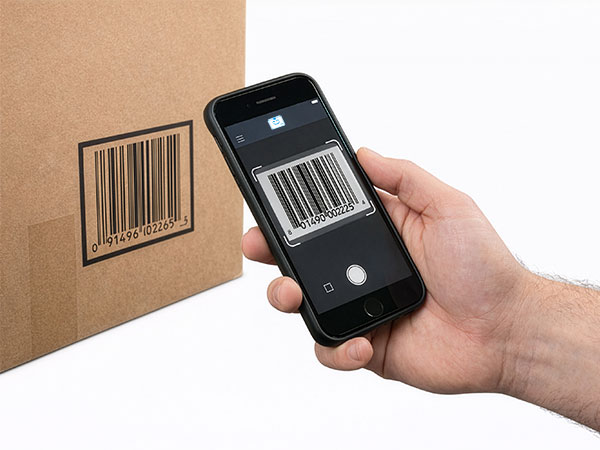
StockZip is our product, so here is the honest positioning: it is the scan-first, mobile-first pick for a small team that wants to track, count, and organize stock fast — without buying an ERP, an MRP, or a full warehouse system. The core loop is a phone barcode or QR scan, nested folders and locations, low-stock alerts, item photos, and CSV import and export, and that core is free forever for up to 10 items and one user, with no credit card. Paid plans add the operational layer as you need it: Starter unlocks check-in/check-out, cycle counts, custom fields, label printing, an audit trail, and reports; Pro adds the full order chain — pick lists, sales and purchase orders, receiving, invoices, transfers, lot and serial tracking, and integrations. Pricing is flat with a bundled user allowance, and the price you sign up at is the price you renew at, in writing — no first-year intro rate that steps up in year two.
The honest limitation: StockZip is not a warehouse management system and does not pretend to be. There is no slotting optimization, no wave or zone picking, no dock or yard scheduling, and no labor management — if you run a fulfillment operation that needs those, look at a real WMS (we cover that in our warehouse roundup). It is also not an MRP or accounting package: it does not run bills of materials or production planning like Katana or Fishbowl, and it does not keep your books. What it does, it does quickly and cheaply — fast, accurate, mobile stock tracking that a non-technical team will actually use every day. If that is the job, StockZip is the value pick; if you need manufacturing or true warehouse operations, one of the tools above fits better.
Three mistakes buyers make
The first mistake is buying for the feature list instead of the daily workflow. A tool with a hundred features you will never open is not better than one that nails the five things your team does every hour. Manufacturing modules, EDI, and slotting logic look impressive in a demo and become dead weight if you resell finished goods from a single location. Buy for the job you do all day, and treat everything else as a bonus you are not paying a premium for.
The second mistake is under-pricing growth. The advertised number is almost always a floor, not a ceiling: per-seat charges climb with your headcount, order-metered plans bump you a tier during a busy season, extra warehouses and integrations are sometimes billed separately, and first-year discounts renew higher. Before you commit, model your second year at your expected team size and volume — not your first year at today’s numbers. The cheapest-looking plan often loses that math to a flat plan with a bundled user allowance and a locked renewal rate.
The third mistake is ignoring the exit. You should be able to leave any tool with your full catalog and history intact via a plain CSV export, with no lock-in contract holding your data hostage. Data portability is not a nice-to-have; it is the insurance policy that lets you switch when a tool stops fitting. Confirm export before you import — it is far easier to check on day one than to discover on the day you want to move.
Which one is right for you
Match the tool to the shape of your work, not to the longest feature list. If your catalog is photo-driven — equipment, props, field gear — Sortly leads, with StockZip as the lower-renewal-cost alternative. If your day is measured in ecommerce orders and you already live in Zoho, Zoho Inventory fits. If you are a wholesaler or distributor who needs purchasing and B2B ordering built in, inFlow is purpose-built.
If you manufacture, the split is by ecosystem: Fishbowl if you are tethered to QuickBooks and want proven manufacturing depth, Katana if you want a modern, production-planning MRP for makers. If you sell across many channels at real volume, Cin7 is built for that omnichannel complexity. And if you are a small team that mostly needs to scan, count, and organize stock quickly at a predictable price, StockZip is the scan-first pick — provided you do not need a full WMS or an MRP, in which case buy the heavier tool on purpose.
The bottom line
There is no single best inventory management software — there is the best fit for your inventory, your team size, and your budget. Shortlist by use-case first, then price your second year (not your first) and confirm you can export your data before you commit. Start on a genuine free tier where one exists, and only move up a plan when you have actually outgrown it.
If your reality is a small team that wants to track stock fast from a phone without an enterprise bill, try StockZip free for 14 days and grow into paid tiers only as you need orders, reports, or a bigger user allowance. If your reality is manufacturing, multichannel, or full warehouse operations, one of the other six tools here is the more honest choice — and picking the right heavy tool on purpose beats forcing a light one to do a job it was never built for.