
Ecommerce inventory management software keeps online orders, stock counts, and multiple warehouses in sync. Here is what matters when you choose a platform, and how five categories of tools compare for online sellers.
Why ecommerce sellers outgrow spreadsheets and built-in tools
Spreadsheets and a store platform’s built-in stock field work when you have a handful of products and one sales channel. As you grow, the cracks show: manual updates are slow and error-prone, and every typo becomes a discrepancy that compounds over the month.
The bigger gaps are structural. A spreadsheet gives you no visibility across locations when stock sits in more than one warehouse, fulfillment center, or pop-up. It gives you no proactive alerts, so you learn you are out of stock when a customer complains, not before. And it gives you no audit trail — when a count is wrong, you have no idea who changed what, or when.
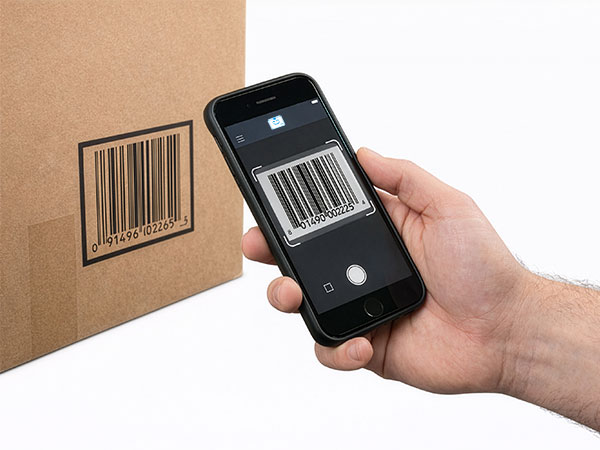
Dedicated ecommerce inventory management software closes those gaps with barcode scanning for faster, more accurate counts, low-stock alerts for proactive reordering, per-location stock levels as one source of truth, and an audit trail for accountability.
How to choose an ecommerce inventory platform
Not every feature matters equally. Five criteria separate a tool that sticks from one your team abandons.
• Barcode scanning: reduces data-entry errors and speeds up receiving, picking, and counting several times over. Ask whether it supports phone-camera scanning, whether Bluetooth scanners work, and whether scanning works offline.
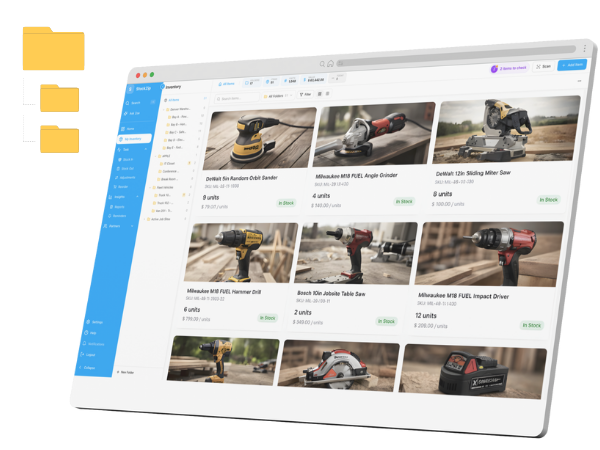
• Multi-warehouse organization: essential once inventory lives in more than one place. Ask whether you can organize stock by warehouse, transfer between them, and whether the folder hierarchy is included in the base price.
• Low-stock alerts: prevent stockouts by notifying you before an item runs out. Ask whether thresholds are per-SKU, how alerts are delivered, and whether you can set reorder points.
• Pricing transparency: avoid surprise costs as you grow. Ask whether there are SKU or item limits, what happens when you exceed them, and whether there is a genuine free tier to test with.
• Data portability: you should be able to leave. Ask whether you can export to CSV, whether you can export full history, and whether there is a lock-in contract.
Five categories of ecommerce inventory software, compared
Most tools for online sellers fall into one of five categories. Match the category to how your inventory actually moves rather than to the longest feature list.
• Scan-first simplicity (where StockZip sits): built for small teams and warehouse-plus-ecommerce hybrids that want offline mode, check-in/check-out, fast barcode scanning, and predictable pricing. The trade-off is fewer native channel integrations, so a CSV-based workflow does the connecting.
• Photo-first apps: strong for visual organization, label printing, and photo-heavy catalogs. Best when a picture of the item matters more than a scan-first field workflow.
• Order-centric systems: built around purchasing and sales workflows, with purchase orders, sales orders, and reporting. A good fit for wholesale and B2B sellers, at the cost of more configuration.
• Manufacturing and warehouse suites: production workflows, BOMs, multi-warehouse, and deep controls for manufacturers and advanced operations. Usually a longer setup and broader scope than most ecommerce sellers need.
• Omnichannel platforms: multi-channel sync, sales-channel integrations, 3PL support, automation, and EDI for high-volume sellers across many channels. More moving parts, and implementation effort varies.
Recommendations by business size
Solo seller: start free to validate your workflow. Prioritize mobile scanning, easy CSV import, and a routine you can run every day. StockZip’s free tier covers 10 items with no card.
Small team (2–10): look for multi-user access, role permissions, and activity history. Watch for per-user pricing that grows faster than your headcount — a flat plan with a bundled user allowance is safer.
Multi-warehouse or high volume: prioritize multi-warehouse support, channel integrations, automation, and a clear implementation plan. This is where an order-centric or omnichannel platform earns its heavier setup.
What is the best ecommerce inventory management software for small businesses?
For small ecommerce sellers, the best inventory management software is the one your team will use every day: easy setup, phone barcode scanning, low-stock alerts, and predictable pricing. Start with fast receiving and cycle counts rather than a long feature list you will never touch.
How much does ecommerce inventory software cost in 2026?
Pricing varies widely. Genuine free tiers exist but usually cap items or users. Paid plans typically run from about $15 to $99 a month for small teams and $200+ a month for enterprises with multiple warehouses. Watch for per-SKU or per-seat charges that spike as you grow. StockZip is free for 10 items, and paid plans start at $15 a month billed annually.
Do I need inventory software if I use Shopify?
Shopify has basic stock tracking, but dedicated ecommerce inventory management software adds barcode scanning, organization across multiple warehouses, low-stock alerts, and an audit trail. If you sell on more than one channel or hold stock in more than one place, standalone inventory software is usually worth it.
What features are essential for ecommerce inventory management?
The essentials are barcode or QR scanning for speed and accuracy, low-stock alerts with per-SKU thresholds, organization across multiple warehouses, CSV import/export for data portability, and a mobile app for warehouse work. Everything else is a nice-to-have.
Can inventory software prevent overselling?
Yes. Keeping counts accurate through scan-based workflows and real-time updates removes the data drift that causes overselling. Some platforms also sync available quantities directly with your sales channels so listings update automatically.