

Cycle Count
A cycle count is an inventory audit method that counts a small subset of items on a rotating schedule, so the whole catalog gets verified over time without shutting the floor down for a full physical count.
How cycle counting works
A team counts a small, scheduled set of items each day or week — instead of the entire warehouse at once — compares the count to system quantities, and corrects any differences immediately. Over a full cycle, every item gets counted without ever shutting the floor down for a single big count. Which items get counted on a given day usually comes from a fixed rotation, a random sample within each ABC tier, or a trigger like a location that just had unusually high transaction volume.
Why cycle counts beat a full physical count
A full physical count is disruptive — it usually means closing the floor or freezing shipments for a day — and it finds errors late, since a mistake made in February might not surface until the annual count in December. Cycle counts spread the same work across the year and surface variances within days of when they happen, making inventory accuracy part of normal operations rather than an annual event. Some businesses keep a smaller annual or year-end count on top of cycle counting anyway, mainly for accounting or compliance reasons, but they lean on cycle counts for the accuracy that actually drives day-to-day decisions.
What to count first
Start with high-value, fast-moving, and frequently wrong items. These items create the most operational risk when counts are inaccurate, which is also why they’re the natural starting point for an ABC-analysis-driven count schedule.
Worked example: cycle counting a 1,200-SKU warehouse
A distributor with 1,200 SKUs assigns 40 SKUs to count each business day. At that pace, the entire warehouse gets counted every 30 business days — about six weeks — without ever closing the floor or pausing shipments for a full physical count.
On a Tuesday count of 40 A-tier SKUs, three show variances. One item’s system count says 85 units but the shelf has 79 — a 6-unit gap traced back to a bin transfer that was carried out but never logged. Because the count happens the same week the transfer occurred, the gap is corrected immediately and the transfer process gets a barcode-scan step added, instead of the discrepancy sitting undetected until a year-end count months later.
Common mistakes with cycle counting
A cycle count program tends to break down in a few predictable ways:
• Counting the same easy, well-organized SKUs every cycle and quietly skipping the messy or hard-to-reach ones, which defeats the purpose of full-catalog coverage.
• Correcting a variance without investigating the cause, so the same root problem — a mislabeled bin, an unlogged transfer — keeps generating new variances.
• Counting every item on the same schedule regardless of value or movement, instead of counting A-tier items more often than C-tier items.
• Letting cycle counts slip when the team gets busy — a schedule that only runs when there’s spare time isn’t a schedule.
How cycle counting works in StockZip
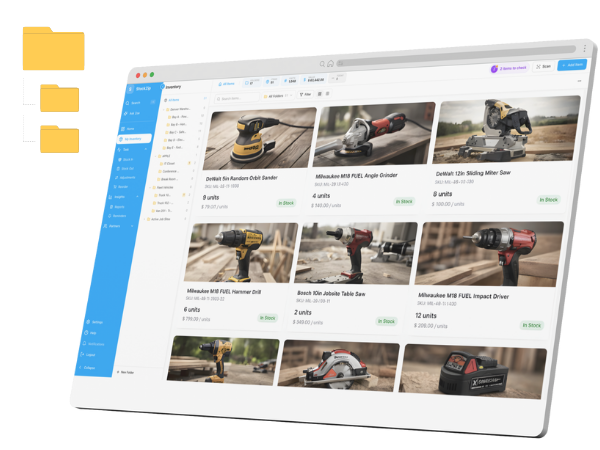
StockZip’s stock count task lets a team schedule a count against a subset of items — a location, a tag, or a manually chosen list — and scan through it with a barcode scanner instead of a clipboard. Variances are logged against the item’s movement history the moment the count is submitted, so a six-unit gap gets corrected the same day instead of waiting for the next full count.
Frequently asked questions
What is a cycle count?
A cycle count is a recurring count of a subset of inventory used to maintain accuracy throughout the year.
How often should cycle counts happen?
High-value and fast-moving items can be counted weekly, while lower-risk items can be counted monthly or quarterly.
Do cycle counts replace physical inventory?
They can reduce the need for disruptive full counts, but some businesses still run periodic full counts for compliance or accounting.
How is a cycle count different from a full physical count?
A cycle count checks a small subset of items on a rotating schedule; a full physical count checks every item at once, usually requiring a shutdown or a dedicated count day.
What should trigger an investigation instead of just a correction?
Any variance above a set threshold, or a pattern of variances on the same item or location — those usually point to a process gap rather than a one-off counting mistake.
Can StockZip support cycle counting?
Yes. StockZip supports scan-based counts and inventory adjustments with audit history.