

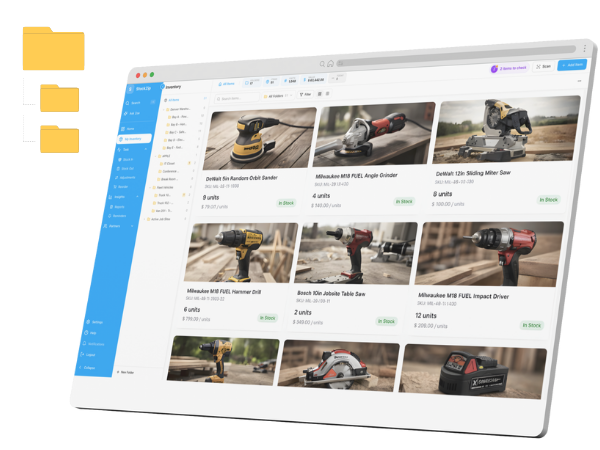
Perpetual Inventory
Perpetual inventory is a system that updates on-hand stock in real time, per transaction — every receipt, sale, transfer, check-out, and adjustment changes the count the moment it happens, so the number on screen is meant to match the shelf at any given moment.
How perpetual inventory works
Perpetual inventory updates stock continuously, per transaction, instead of waiting for a scheduled count. Every movement updates the system as it happens — receiving, sales, transfers, check-outs, returns, and manual corrections all adjust the on-hand quantity immediately, so the number on screen is meant to match what is physically on the shelf at any given moment, not just after the next count.
Why scanning matters
Perpetual inventory depends on fast, accurate updates at the moment stock actually moves. Barcode scanning reduces typing and makes it realistic for a busy team to log a transaction in seconds rather than skip it because updating a spreadsheet felt like extra work. Without scanning, most perpetual systems slowly drift back toward periodic behavior, because manual entry gets skipped under time pressure.
Perpetual inventory risks
If people skip updates, the system can look precise while being quietly wrong — a quantity that updates instantly is still only as accurate as the transactions that were actually logged. A missed transfer, an unrecorded return, or a sale rung up under the wrong item all leave the system confidently displaying the wrong number. Cycle counting and a full audit trail on every change are what keep a perpetual system trustworthy rather than just fast.
Worked example: a sale under perpetual inventory
A boutique running a perpetual inventory system sells a $45 jacket. The instant the sale is rung up at the register, the system deducts one unit — on-hand quantity drops from 12 to 11 automatically, without anyone touching a spreadsheet or a count sheet.
A manager checking the dashboard five minutes later sees exactly 11 jackets on hand, matching what’s actually on the rack. Compare that to a periodic system, where the same sale wouldn’t be reflected in the books until the next scheduled count — the dashboard might still say 12 for days or weeks after the jacket sold. That real-time accuracy is also what lets a low-stock alert fire the moment a threshold is crossed, instead of only being discovered at the next count.
Common mistakes with perpetual inventory
A perpetual system fails in specific, avoidable ways:
• Assuming perpetual updates mean the counts are automatically accurate — a system that updates instantly on a wrong transaction just produces a wrong number faster.
• Skipping cycle counts because the system "already knows" the quantity, which lets shrinkage, damage, and unlogged movements accumulate unnoticed.
• Letting staff bypass the scan-to-update step for "quick" transactions, which quietly breaks the perpetual chain for exactly the items handled most casually.
• Running perpetual inventory without an audit trail on who changed what and when, which makes it hard to trace a wrong quantity back to its cause.
How perpetual inventory works in StockZip
StockZip is built as a perpetual system by default — receiving, check-in/check-out, transfers, and manual adjustments each update on-hand quantity immediately and record the change in the item’s movement history with a timestamp and actor. Cycle counts still run on top of that to catch the gap between what the system says and what’s actually on the shelf, and low-stock alerts key off the same live quantity rather than a number that could be weeks out of date.
Frequently asked questions
What is perpetual inventory?
Perpetual inventory is a system that updates stock continuously as inventory transactions happen.
Is perpetual inventory good for small business?
Yes, when the workflow is simple enough for the team to maintain. Barcode scanning makes this much easier.
Does perpetual inventory still need counts?
Yes. Cycle counts are still needed to catch mistakes, shrinkage, and process gaps.
What triggers an update in a perpetual system?
Any recorded transaction against an item — a sale, receipt, transfer, check-out, check-in, or manual adjustment. If a movement isn’t recorded, the perpetual count doesn’t reflect it.
Is perpetual inventory more accurate than periodic inventory?
It’s more current, not automatically more accurate — accuracy still depends on every movement actually being logged. Combined with cycle counts, it’s typically both more current and more accurate.
Can StockZip run perpetual inventory?
Yes. StockZip updates inventory as teams scan, check items in or out, transfer stock, receive orders, and adjust counts.