

Reorder Point
A reorder point is the on-hand quantity that triggers a new purchase order — set so stock lasts through the supplier lead time without running out. The base formula is (lead time × average daily demand) + safety stock.
Reorder point formula
A reorder point is the on-hand quantity that triggers a new purchase order. The base formula is: reorder point = (lead time × average daily demand) + safety stock. The first term covers ordinary usage while a business waits on the next shipment; the safety stock term covers usage that runs above ordinary.
Why reorder points matter
Reorder points turn purchasing from a gut-feel judgment call into a repeatable number anyone on the team can act on. They matter most for parts, consumables, and fast movers — the items where “I’ll order more soon” quietly turns into a stockout.
How to maintain reorder points
A reorder point calculated once and never revisited goes stale fast. Review it whenever daily usage shifts, a supplier’s lead time changes, or a product moves into or out of a season — all three inputs to the formula are moving targets, not constants.
Reorder point worked example
A hardware store sells a specific gauge of electrical wire at an average of 20 units a day. Its supplier’s lead time is 7 days, and the store wants to hold 50 units of safety stock to cover unusually busy weeks. Using the formula: reorder point = (7 × 20) + 50 = 190 units.
That means the moment on-hand quantity for that wire drops to 190, the store places a new order — not when the shelf visibly looks low, and not when someone happens to notice. At 20 units sold per day, 190 units covers the full 7-day wait plus the 50-unit buffer, so a new shipment should land before the buffer itself gets touched.
If usage climbs to 25 units a day during a busy stretch, the same 190-unit trigger now covers only about 7.6 days instead of the intended 7 plus buffer, which is exactly the scenario safety stock is meant to absorb. That is also the signal that it is time to recalculate the reorder point with the new daily usage figure rather than keep ordering against a number that no longer matches reality.
Common mistakes with reorder points
A handful of mistakes account for most reorder point failures:
• Using a single company-wide lead time for every item instead of each supplier’s actual observed lead time — a fast-shipping supplier and a slow one need very different reorder points.
• Calculating the reorder point once at setup and never updating it as demand grows, shrinks, or turns seasonal.
• Confusing the reorder point (when to order) with the order quantity (how much to order) — hitting the trigger correctly but then ordering an arbitrary amount defeats the purpose.
• Leaving safety stock out of the formula entirely, which turns the reorder point into a number that only works if nothing ever goes wrong.
How reorder points work in StockZip
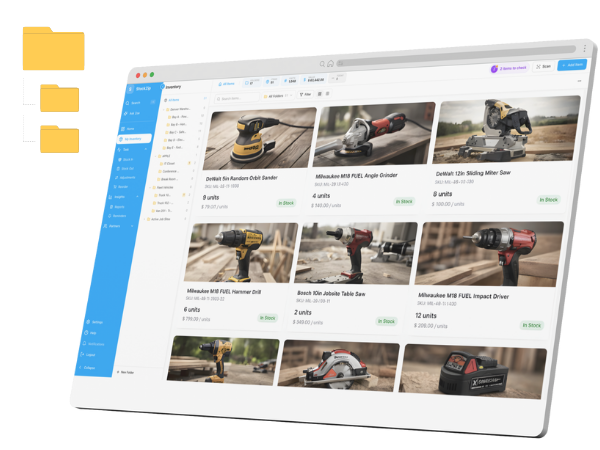
In StockZip, the reorder point is the threshold behind low-stock alerts — set it on an item and StockZip flags the item automatically once on-hand quantity crosses it, instead of relying on someone to spot it on the shelf. The reorder point calculator helps size that number from lead time and usage before it ever gets typed into an item record.
Frequently asked questions
What is a reorder point?
A reorder point is the quantity where a business should order more stock to avoid running out.
How do you calculate reorder point?
Reorder point = (lead time × average daily demand) + safety stock. For example, a 7-day lead time at 20 units a day plus 50 units of safety stock gives a reorder point of 190.
Is reorder point the same as minimum stock?
They are closely related. Minimum stock is often used as the alert threshold, while reorder point is the purchasing trigger — in most small businesses the two numbers are the same.
What inputs does the reorder point formula need?
Average daily demand, supplier lead time in days, and a safety stock buffer. All three should come from real, recent data rather than estimates.
What happens if the reorder point is set too low?
The business runs out of stock before the replacement order arrives, because the trigger fires too late to cover the full lead-time gap.
Can StockZip send reorder alerts?
Yes. StockZip supports low-stock alerts based on item thresholds set at or above the reorder point.