

Safety Stock
Safety stock is extra inventory held above expected demand during the replenishment window to protect against stockouts caused by demand spikes, supplier delays, or count errors. It is a buffer sized to each item's demand variability and lead time.
What safety stock means
Safety stock is the buffer held above expected demand during the replenishment window. It exists because real demand and real lead times are never perfectly predictable — a supplier ships two days late, a slow week turns into a rush, or a count comes in short. The buffer absorbs that variability before it turns into a stockout.
When to use safety stock
Safety stock earns its keep on items where running out causes a real cost: lost sales, a stalled job, a missed delivery date, or an emergency purchase at a markup. It is not a fix for chronic count errors or an unreliable supplier — those problems should be solved directly, with safety stock covering only what is left after the fix.
How to reduce safety stock without increasing risk
The lever most businesses miss is variability, not volume. Every day shaved off a supplier’s lead time, and every point of forecasting accuracy gained, lets a business hold less buffer while keeping the same protection. Better supplier scorecards, tighter cycle counts, and earlier low-stock alerts all reduce the safety stock a business actually needs.
How to calculate safety stock (worked example)
The most common formula for small and mid-size operations is the max-min method: safety stock = (maximum daily usage × maximum lead time) − (average daily usage × average lead time). It uses the worst case a business has actually seen, not a guess.
Take a garden supply store stocking a popular 40-lb fertilizer bag. On a typical day it sells 20 bags, and its supplier delivers in 7 days on average. During spring rushes, daily sales have spiked to 30 bags, and the same supplier has taken as long as 10 days to deliver. Plugging those numbers in: (30 × 10) − (20 × 7) = 300 − 140 = 160 bags of safety stock.
Businesses that want a statistically grounded number instead of a worst-case snapshot use the z-score method instead: safety stock = Z × the standard deviation of demand during lead time. Z corresponds to how often stockouts are acceptable — 1.28 covers a 90% service level, 1.65 covers 95%, and 2.33 covers 99%. A store willing to occasionally run short on a low-cost fastener might plan around Z = 1.28; the same store protecting a part that stops a customer’s repair job might plan around Z = 2.33.
Common mistakes with safety stock
Safety stock calculations tend to fail in the same handful of ways:
• Setting one blanket safety stock number for every item instead of sizing it to each item’s actual demand variability and lead time.
• Treating safety stock as a substitute for fixing a chronically late supplier or a chronically wrong count, instead of a buffer for what those fixes can’t fully eliminate.
• Never revisiting the number after it’s set — a safety stock level calculated during a slow season can be dangerously low once demand picks up.
• Padding safety stock “just in case” on low-value, easy-to-reorder items, which quietly ties up cash and shelf space that A-tier items need more.
How safety stock works in StockZip
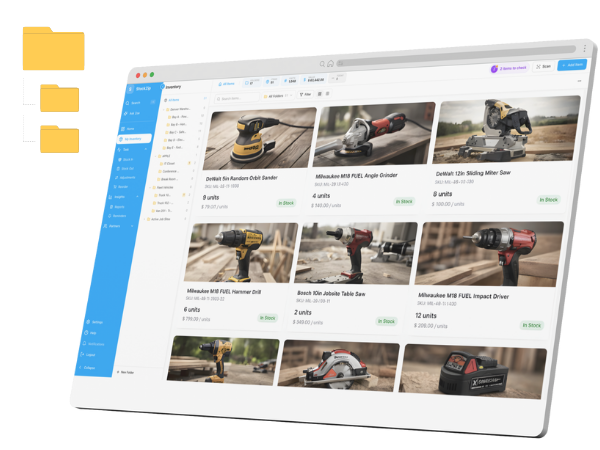
StockZip doesn’t auto-calculate safety stock, but it gives you the inputs the formula needs: real, timestamped movement history per item to measure demand variability, and low-stock alerts that fire against a minimum threshold you set — which is where the safety stock number typically lives. Once it’s set, StockZip flags the item the moment on-hand quantity crosses that line instead of waiting for someone to notice an empty shelf.
Frequently asked questions
What is safety stock?
Safety stock is extra inventory kept as a buffer against demand spikes, supplier delays, or count errors.
Is safety stock the same as reorder point?
No. Safety stock is the buffer. Reorder point is the level where you order more, often calculated as usage during lead time plus safety stock.
Can too much safety stock be bad?
Yes. Too much safety stock ties up cash, takes storage space, and can become dead stock.
How do you calculate safety stock?
A common formula is (maximum daily usage × maximum lead time) − (average daily usage × average lead time). A more statistical approach multiplies a service-level factor — 1.28 for 90%, 1.65 for 95%, or 2.33 for 99% — by the standard deviation of demand during lead time.
Does every item need safety stock?
No. It matters most on items where a stockout is expensive — lost sales, stalled jobs, emergency orders. Low-cost, easy-to-reorder items usually need little or none.
How does StockZip help with safety stock?
StockZip helps teams track actual counts, set reorder points that include a safety stock buffer, and receive low-stock alerts before inventory runs out.