
SKU (Stock Keeping Unit)
A SKU (stock keeping unit) is a unique internal code a business assigns to identify and track a specific product or variant — separate from the manufacturer's barcode. It lets you count, search, reorder, and report on that exact item.
What SKU means
SKU stands for stock keeping unit — an identifier a business creates internally to track a specific product or variant. That’s the key difference from a manufacturer barcode: a SKU belongs to the business, while a UPC or EAN barcode is assigned by (or on behalf of) the manufacturer and travels with the product everywhere it’s sold.
SKU vs barcode
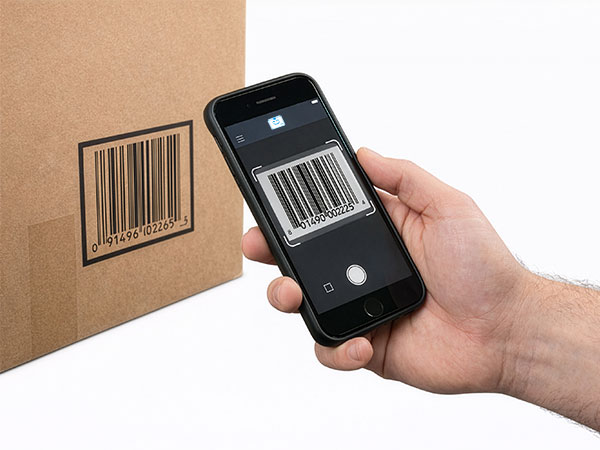
A SKU is the identifier a business chooses; a barcode is a machine-readable symbol that can be scanned instead of typed. A barcode often encodes a UPC or EAN rather than the SKU itself, so the same barcode can point to different SKUs at different retailers, and the same SKU can have no barcode at all if a product is unbranded or custom-made. Scanning reads the barcode; the SKU is what the item is actually filed under once that scan resolves to a record.
Good SKU habits
A workable SKU scheme has three properties: every SKU is unique, no two items ever share one; SKUs are stable, they don’t change when a supplier or shelf location changes; and SKUs aren’t overloaded with encoded meaning that will eventually go stale, like a supplier code baked into the string for a supplier that gets swapped out next year. A short, predictable pattern — category, product, variant — tends to age better than one built to describe every fact known about the item on day one.
Worked example: building a SKU scheme
A candle shop sells a lavender-scented candle in three sizes. Rather than relying on the manufacturer barcode — which turns out to be identical on the 4oz and 8oz jars because of a labeling mix-up at the factory — the owner assigns her own SKUs: CNDL-LAV-04, CNDL-LAV-08, and CNDL-LAV-16, where the suffix is the size in ounces.
That single decision fixes two problems at once. When a customer asks how many lavender candles are in stock, the owner can total all three SKUs for a category-level answer. When it’s time to reorder, the purchase order only needs the exact SKU for the size that’s actually running low, instead of a size-ambiguous barcode that could mean either jar. The scheme scales cleanly, too — adding a new scent later means a new prefix, not a rethink of the whole system.
Common mistakes with SKUs
Most SKU problems trace back to one of these:
• Reusing a manufacturer’s barcode as the SKU, then discovering — like the candle shop above — that the barcode isn’t actually unique per variant.
• Encoding a supplier code or shelf location into the SKU string, which breaks the SKU the next time the supplier or location changes.
• Letting two different products share a SKU because a new item was created by copying an old one and the code was never updated.
• Changing a SKU after it’s already been used on invoices, purchase orders, or past reports, which orphans historical data from the item it used to describe.
How SKUs work in StockZip
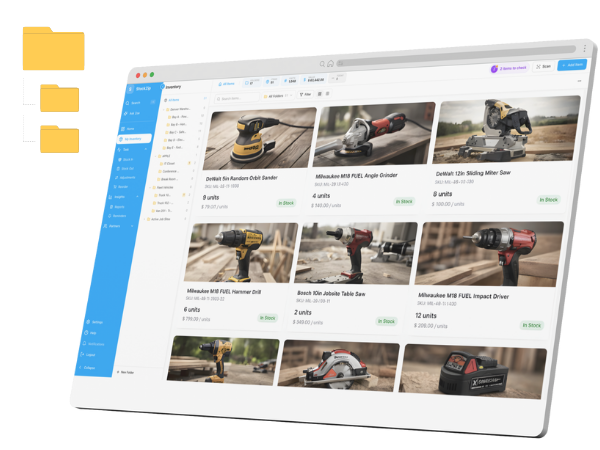
Every item in StockZip has a SKU field alongside its barcode value, so the two can be tracked separately even when a manufacturer barcode is missing, reused, or inconsistent across variants. Barcode scanning works off whichever code is on the label, while search, reporting, and reorder points key off the SKU the business actually controls.
Frequently asked questions
What does SKU stand for?
SKU stands for stock keeping unit.
Is a SKU the same as a barcode?
No. A SKU is an internal item code. A barcode is a scannable code that can represent that SKU.
Do small businesses need SKUs?
Yes, if they track more than a small handful of items. SKUs make searching, counting, importing, and reporting easier.
Can a SKU and a barcode be the same value?
They can — some businesses print their SKU as a barcode. But they don’t have to match, and for products with an existing manufacturer barcode, they usually won’t.
What makes a bad SKU?
A SKU that isn’t unique, that changes over time, or that encodes information — like a supplier name or a price — that is likely to change independently of the product itself.
Can StockZip create item codes?
StockZip can store item codes and barcode values so teams can scan and manage inventory consistently.