

Scanning a barcode with a phone
Scan with your phone

Count, move, and find stock with the camera already in your pocket. Works offline, syncs later.

Try the live demo →
Organized stock on shelves
Switching from Sortly?

Bring folders, photos, and history over in an afternoon — with pricing that stays predictable at renewal.

See pricing →
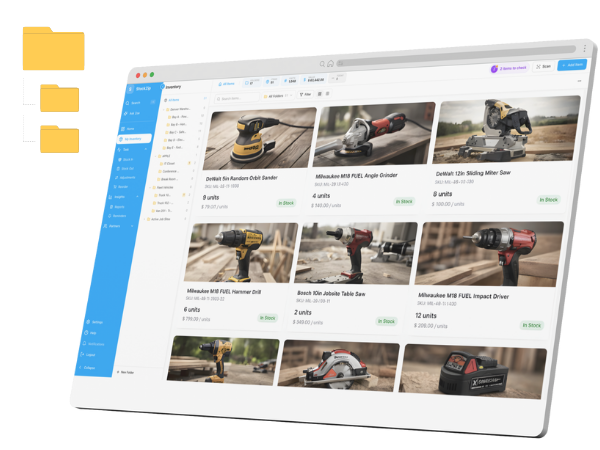
Folder-style inventory list
Free spreadsheet templates

Excel, Google Sheets, and printable count sheets — ready to download, no signup needed.

Get the templates →
Home › Learn › Templates › Asset inventory template

Free asset inventory template — printable fixed-asset register

A working register for every asset the business owns: what it is, its tag ID, where it lives, who is responsible for it, what it cost, and its condition. Print it for a walk-round audit or fill it in on screen. No email, no watermark.

Jump to the printable register

Free · no email required · print or fill in · updated July 2026

For the walk-round audit

The printable asset register

This is the whole template — right here on the page, free and un-gated. Print it for a clipboard audit, or use the field guide below to rebuild it in any spreadsheet. No download, no email, nothing to unzip.

  • A Tag ID column so every row ties to one physical, uniquely tagged asset
  • Assigned-to and Location columns — the accountability that makes an audit possible
  • Blank rows sized to write in with a pen on a clipboard
Opens your browser print dialog
ASSET INVENTORY REGISTERPage 1 of 1
Site: Date: Audited by: Dept:
AssetTag IDCategoryLocationAssignedCond.
stockzip.app/learn/templates — free to copy and share

What goes on an asset inventory

Eight columns capture everything a fixed-asset register needs — the tag ID, assigned-to and condition columns are what turn a plain list into an accountability record.

ColumnWhat it capturesExample
AssetWhat the item isDell Latitude 7440 laptop
Tag / IDThe unique, durable asset tagAST-0142
CategoryIT · furniture · equipment · vehicle · fixtureIT hardware
LocationWhere the asset physically livesHQ · 2nd floor
Assigned toThe person or department responsibleSarah M. — Sales
Purchase dateWhen it was bought (for depreciation)2025-03-11
ValuePurchase cost or current book value$1,450
ConditionIn use · storage · repair · retiredIn use — good

What counts as a fixed asset

Anything durable the business keeps and uses rather than sells — each tracked as its own tagged item with an owner and a value.

IT & electronics

Laptops, monitors, phones, servers and networking kit — high value, high churn, easy to lose.

Furniture & fixtures

Desks, chairs, shelving and fit-out that stays with a location.

Tools & equipment

Power tools, test gear, machinery and portable equipment loaned between people.

Vehicles

Vans, forklifts and trailers — tagged, valued and assigned to a driver or site.

Common asset register mistakes

No unique tag — Two identical laptops with no tag are impossible to tell apart on the register.
No owner — An asset assigned to “the office” is an asset nobody will admit losing.
Never updating condition — Retired kit left as “in use” inflates the numbers and the insurance value.
Missing purchase date and value — Without them the register cannot support depreciation or an insurance claim.
One register that never gets audited — A list nobody walks round and checks drifts out of date within a quarter.

How to use these templates

1
Give every asset one durable tag
A stuck-on asset tag or engraved ID that never changes, even if the item moves or is reassigned. The tag is what ties a row to a physical thing.
2
Record where it is and who holds it
Location and Assigned-to are the accountability columns. A laptop with no owner is a laptop nobody will admit losing.
3
Log purchase date and value
Capture what it cost and when, so the register doubles as the basis for depreciation and insurance claims — not just a headcount.
4
Keep the condition/status current
In use, in storage, in repair or retired. Walk round once a quarter and update the status so retired kit stops inflating the numbers.

Template questions

What is included in an asset inventory?
A fixed-asset register lists, for every asset: a name, a unique tag or ID, a category, its location, the person or department responsible, the purchase date and value, and its current condition or status. The tag ID, assigned-to and condition columns are what make it an accountability record rather than a plain list — they tell you not just what you own but who has it and whether it still works.
What is the difference between an asset inventory and a stock inventory?
A stock (or product) inventory tracks consumable items you buy and sell, counted by quantity. An asset inventory tracks durable things the business keeps and uses — laptops, tools, furniture, vehicles — each as a uniquely tagged individual item with an owner and a value, not a count.
Why does every asset need a unique tag or ID?
Because two identical laptops are different assets — different owners, different purchase dates, different conditions. A durable tag ID lets you tell them apart, tie each row to a physical item, and check one in or out to a person without ambiguity.
When should I stop using a paper asset register?
When assets move between people or sites, when you need a history of who had what, or when the spreadsheet is too big to audit by eye. That is usually the point where scanning an asset tag to check it in or out — with a timestamped audit trail — pays for itself.

Skip the clipboard — scan an asset tag to find it

StockZip lets you organise assets into folders by location, scan each tag to pull up the record, and photo-tag the item so it is unmistakable. Check-in / check-out — scanning an asset out to a person and back in with an audit trail — is on the Starter plan and up. Free for your first 100 items.

See asset trackingCheck-in / check-out

Keep exploring

All templates →
Free asset inventory template
Print it — no email
Jump to the register