

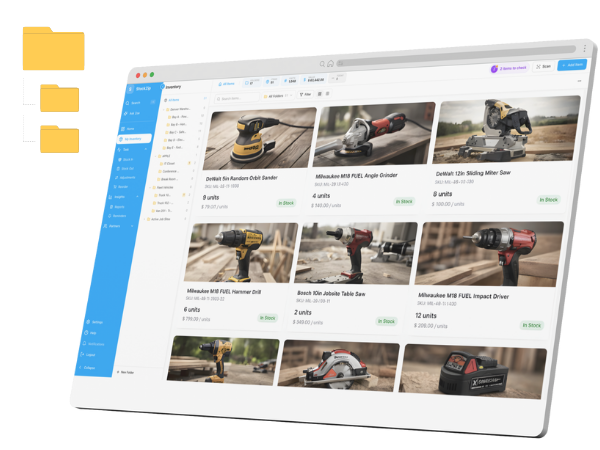
This case-study page is structured for a real customer interview. Until approved customer details are available, it describes the fiber contractor workflow without inventing names, quotes, or metrics.
The fiber contractor inventory problem
Fiber contractors manage cable reels, splice trays, connectors, fusion splicers, OTDR test equipment, PPE, and tools across warehouses, vans, and active job sites.
Without scan records, teams lose time calling technicians, driving back for parts, or replacing equipment that is sitting in the wrong van. Across the trades, unsystematic tool and truck tracking is commonly cited as driving roughly 8 to 15 percent annual shrinkage in tool assets — a cost that lands hardest when a single missing splicer or OTDR stalls a crew.
A scan-first workflow for job sites
A practical workflow is to scan cable and equipment when loaded onto a van, check tools out to technicians, and transfer consumables to the job site location as they are used.
What to track
Track cable type, remaining length, van or job-site location, technician assignment, serial numbers for equipment, and reorder points for consumables.
Customer details pending approval
Specific customer name, job-site count, time saved, accuracy improvement, and direct quotes should be added only after the customer interview and publication approval.
Can fiber contractors track cable reels in StockZip?
Yes. Create items for cable reels and track location, type, remaining length, and movements between warehouse, van, and job site.
Can StockZip track tools by technician?
Yes. Check-in/check-out records show who has each tool and when it moved.
Does StockZip work without signal on job sites?
Yes. StockZip supports offline scanning and syncs updates when the device reconnects.
Should this page include a real customer quote?
Yes, but only after customer approval. This implementation intentionally avoids fake names, quotes, or metrics.