
How Shopify tracks inventory across locations, what Stocky adds for purchasing, where the native tools fall short, and when to add a separate system.
How Shopify tracks inventory natively
Every Shopify store has inventory tracking built in, and it works at the level that matters for ecommerce: the variant. Each product variant — a specific size, color, or style — carries its own stock count, and Shopify decrements that count automatically as orders come in, so the number on the product page reflects what is genuinely available to sell. Turn tracking on per variant, and Shopify can also stop overselling by hiding or blocking items when they hit zero.
The admin gives you a dedicated inventory area where you can view and adjust quantities across your whole catalog, see an inventory history that logs how a count changed and why, and bulk-edit stock rather than touching items one at a time. You can import and export inventory by CSV, which makes both the initial load and periodic clean-ups fast. For a store whose inventory is simply the products it sells online, this native layer is capable and needs no add-ons.
It is worth being fair about what Shopify is optimizing for here: accuracy of sellable stock across sales channels. Because inventory, the storefront, and checkout are one system, there is no sync lag between "what the site says is in stock" and "what you actually have" — the count and the catalog are the same record. That tight coupling is Shopify’s real strength, and it is exactly what a bolt-on inventory spreadsheet can never match.
Multi-location inventory and transfers
Shopify supports multiple locations natively, which is more than a lot of store owners realize. You can define separate locations — a warehouse, a retail shop, a 3PL, a pop-up — and Shopify tracks stock per location, so the total available to sell is the sum across every place that holds the item. Orders can be assigned to fulfill from a specific location, and Shopify’s fulfillment logic can route based on where stock actually is.
For moving stock between those locations, Shopify has transfers: you create a transfer to record inventory heading from one location to another, mark it as received when it arrives, and the counts update at both ends. This is genuinely useful for a growing business that keeps stock in more than one place, and it means the multi-location picture stays inside Shopify rather than drifting into a side spreadsheet.
The honest boundary is that Shopify’s multi-location tools are built around selling and fulfilling, not around deep warehouse operations. They tell you how much is where and let you move it, but they do not manage bin locations, pick paths, or the internal logistics of a large distribution center. For most stores that is exactly the right depth; for a serious warehouse operation it is the point where a dedicated system starts to earn its place.
Purchasing and receiving: Stocky and the native gap
Out of the box, the Shopify admin is light on purchasing. You can adjust and receive stock, but there is no full purchase-order-and-vendor workflow in the core inventory screens — which is the single most common thing store owners find missing when they go looking for it. It is fair to say native Shopify tracks what you have far better than it helps you decide what to buy.
Shopify’s own answer is Stocky, a purchasing and inventory app that is included free with the Shopify POS Pro subscription. Stocky adds the demand-and-purchasing layer: create purchase orders, manage suppliers, get reorder suggestions and demand forecasting, and run stocktakes. Positioned honestly, Stocky closes much of the native purchasing gap for stores already on POS Pro — so "Shopify can’t do purchase orders" is not accurate; it is more that purchasing lives in an add-on rather than the core admin.
The nuance to weigh is that Stocky is tied to the POS Pro plan and is oriented, like the rest of Shopify, around products you sell. If you are on Shopify POS Pro and your purchasing needs are retail purchase orders and reorder forecasting, Stocky is a strong, no-extra-cost fit. If you are on a plan without it, or your purchasing and stock needs reach beyond the sales catalog, the purchasing gap is real and worth planning around.
Reporting, barcodes, and the POS side
On reporting, Shopify scales with your plan. Every store gets basic inventory visibility, and higher plans (and Stocky) unlock sharper inventory reports — sell-through, ABC-style analysis, month-end inventory snapshots, and days-of-inventory-remaining views. For a store whose questions are "what is selling, what is dead, and what do I reorder," the reporting is generally there, though the deeper cuts sit behind higher tiers or the purchasing app rather than the base plan.
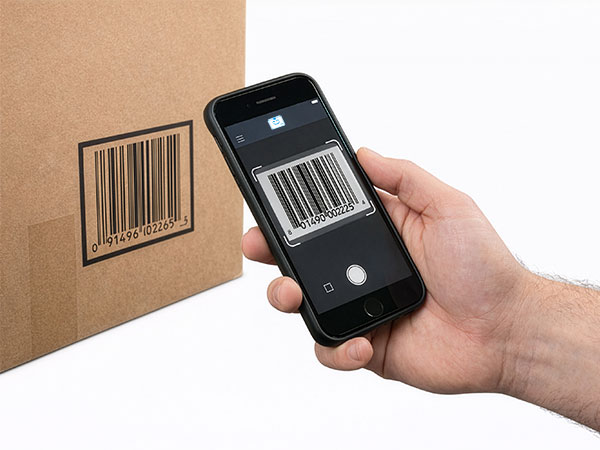
Barcodes and physical retail run through Shopify POS. You can assign barcodes to variants, print barcode labels, and scan items to sell or to count with the POS hardware and app. If you run a physical shop on Shopify POS, the barcode and stocktake tools give you a workable in-store inventory loop that stays connected to the same catalog as your online store.
A few practical habits keep a Shopify inventory accurate. Turn on tracking and "continue selling when out of stock" deliberately, item by item, so you never oversell the things you cannot backorder; keep SKUs and barcodes consistent so reports and scans stay reliable; and run periodic counts against Shopify’s numbers, because even a self-updating system drifts as returns, damage, and miscounts accumulate. The tighter your catalog hygiene, the more you can trust the automatic counts to drive fulfillment without a manual double-check.
The pattern across all of this is consistent: Shopify’s inventory features are excellent when your inventory is your sales catalog and your operations run through Shopify’s storefront and POS. The tools are shaped around selling, and they reward businesses whose inventory question is fundamentally "what can I sell and where is it." The friction shows up when that assumption stops holding.
Where Shopify inventory falls short
Like any commerce platform, Shopify assumes your inventory is the set of products you sell. That is the right assumption for a store — and the reason the tools feel so seamless — but it is also where they run out for a business that is more than a storefront.
The biggest gap is non-sales inventory: raw materials, components, packaging, tools, equipment, fixtures, and assets you own and use rather than list for sale. Shopify tracks sellable variants and decrements them on order; it is not built to track a pallet of packaging, a set of tools checked out to staff, or equipment assigned by asset tag. Businesses that make or assemble products, or that run operations alongside the store, often find their sellable catalog fits Shopify neatly while their back-of-house materials and assets do not.
The other gaps are about workflow reach. Standalone scanning away from the storefront — walking a stockroom, a workshop, or a job site counting and moving items on a phone without touching an order — is not what the Shopify apps are shaped around. Teams whose inventory hub is not the storefront (a warehouse serving multiple channels, field techs stocking vans, a maker tracking work-in-progress) can end up bending Shopify to a job it was not designed for. And deep warehouse logistics — bins, pick paths, internal transfers at scale — sit beyond native Shopify by design.
When to add a separate inventory system
If the gap is inside ecommerce — you want better purchasing, forecasting, and multi-location reporting for the products you sell — stay in the ecosystem first. Add Stocky if you are on POS Pro, or connect one of the many inventory apps that sync with Shopify through its API and share a single catalog. When keeping one synced list of sellable stock is the priority, an app built to integrate with Shopify is the cleaner path, and you should reach for it before anything standalone.
The case for a separate system is different: it is when you have meaningful inventory that will never be a Shopify product — raw materials, tools, equipment, assets, back-of-house supplies — or when you need standalone scanning and check-in/check-out that a storefront tool is not built to provide. Forcing that stock into product records you never intend to sell is the kind of workaround that quietly breaks down.
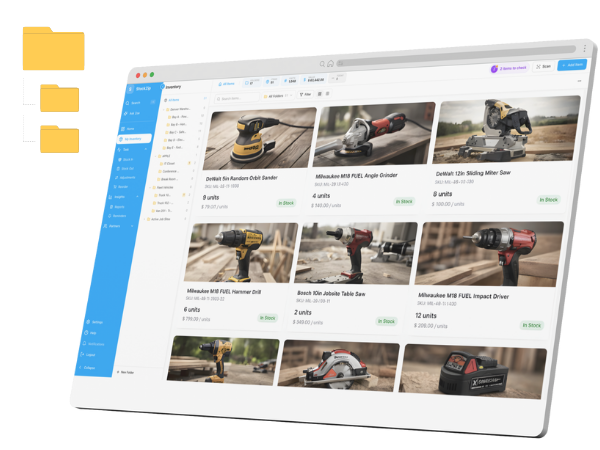
StockZip is one option for that separate role — but be clear about how it connects: StockZip does not integrate directly with Shopify, so there is no live sync between your store and StockZip; you would move data between them by CSV import and export, not an automatic feed. StockZip is a standalone, scan-first system for exactly the inventory Shopify is not built for — materials, tools, equipment, and assets — with barcode scanning, folders and locations, and check-in/check-out on paid plans. Used that way it sits beside Shopify rather than replacing it: Shopify keeps running your storefront and its sellable stock, and a separate tool handles the operational inventory that never appears in your catalog.
Common questions about Shopify inventory
Does Shopify manage inventory automatically? Yes — once you turn on tracking for a variant, Shopify decrements its stock count as orders come in and keeps the number consistent across your storefront and sales channels. You still handle the physical side (receiving new stock and running periodic counts to catch drift), but the sell-side arithmetic is automatic and does not depend on anyone remembering to update a sheet.
Can Shopify handle purchase orders? Not in the core admin, but through Stocky — Shopify’s own purchasing app, included free with the Shopify POS Pro subscription — you get purchase orders, supplier management, demand forecasting, and stocktakes. So the honest answer is that purchasing lives in an add-on rather than the base inventory screens; if you are on POS Pro, that add-on is free and capable.
Does Shopify support multiple locations and transfers? Yes, natively. You can define separate locations, track stock per location, route fulfillment based on where inventory is, and create transfers to move stock between locations with counts updating at both ends. The tools are built around selling and fulfilling rather than internal warehouse logistics, which is the right depth for most stores and the limit for a large distribution operation.
The bottom line
Shopify’s native inventory management is strong for what it is built for: tracking sellable stock accurately across locations and channels, tightly coupled to your storefront and checkout. Add Stocky and it covers purchasing and forecasting for retail too. If your inventory is your product catalog, Shopify plus the right app may be everything you need, and the smart first move is to use the native tools fully before adding anything.
Look beyond it when your inventory stops being purely what you sell — when you are tracking materials, tools, equipment, or assets, or you need standalone scanning your storefront was never meant to do. Then either sync a dedicated app through Shopify’s API for your sellable stock, or run a separate scan-first system alongside it and move data by CSV for the inventory that lives outside the catalog. Match the tool to where your stock actually lives, and neither system has to do a job it was not built for.