
How to manage inventory with Square’s built-in POS tools, what Square for Retail adds, where it falls short, and what to do when you outgrow it.
What Square gives you out of the box
If you already take payments with Square, you already have inventory management — it is built into the free Square Point of Sale app at no extra cost. Every item in your item library can track a stock count, and each sale automatically decrements that count, so the number you see reflects what you have actually sold rather than what you remembered to update. For a small retailer or café whose stock is the same list of things it sells, that alone replaces a spreadsheet.
The free tier covers the essentials well: you can set stock quantities per item and per variation, receive and adjust stock, mark items as sold-out, and turn on low-stock alerts so Square emails you when a count drops below a threshold you set. You can bulk-edit inventory and import your catalog from a CSV, which makes the initial setup fast. Because it is the same system that rings up sales, there is no syncing to worry about and no second app to keep open — the count and the register are one thing.
It is worth being precise about the free-versus-paid line, because it trips people up. Basic inventory tracking — counts, adjustments, low-stock alerts, CSV import — is genuinely free inside Square POS; Square does not charge extra to know how many of something you have. The deeper inventory tooling (purchase orders, cost tracking, advanced counts and reports) is what sits behind the paid Square for Retail plan, covered next. So "does Square charge for inventory management?" has an honest two-part answer: no for the basics, yes for the advanced layer.
The honest framing: Square’s built-in inventory is genuinely good at what it is designed for, which is tracking the sellable items that move through your Square register. It is real, free, and enough for a lot of businesses. The questions worth asking are how much depth you need beyond that, and whether all of your inventory actually passes through the register.
What Square for Retail adds
When the free tools run out, Square’s answer is Square for Retail, a paid plan built specifically for shops that manage real stock. It is a meaningful step up rather than a cosmetic one, and it is fair to say Square invested seriously here — this is not a business that ignores inventory.
The retail plan adds a proper purchasing workflow: create purchase orders, manage vendors, and receive stock against those POs so incoming inventory updates counts automatically. It tracks unit cost and cost of goods sold, so your margins are calculated rather than guessed. It supports full stock counts (and partial counts) with a scan-based counting flow, prints barcode labels, and gives you sharper inventory reporting — sell-through, projected profit, and inventory-by-item views that the free tier does not surface.
Square for Retail also handles multiple locations, keeping separate stock counts per store and letting you transfer stock between them. For a growing multi-store retailer whose inventory is its sales catalog, that combination — POs, vendor management, COGS, counts, labels, and multi-location — covers most of what a dedicated inventory tool would. If your business fits that shape, Square for Retail is a strong, coherent option and you may not need anything else.
How to set up and run inventory in Square
Start by building your item library. Add each product with its name, price, and any variations (size, color, flavor), then enable inventory tracking on the items you want counted. If you already have a catalog in a spreadsheet, use Square’s CSV import to load it in one pass rather than keying items one by one — this is the single biggest time-saver in setup.
Next, set your starting counts and your reorder thresholds. Enter the on-hand quantity for each tracked item, then set a low-stock alert level so Square warns you before you run out. Getting the opening count right matters more than it looks: every future number is that starting figure plus and minus what the system records, so an accurate first count is what keeps the whole ledger trustworthy.
From there, the day-to-day is mostly automatic. Sales reduce counts as they happen; when new stock arrives you receive or adjust it (via a purchase order on Square for Retail, or a manual stock adjustment on the free tier); and you periodically run a physical count to catch the drift that every real inventory picks up from shrinkage, miscounts, and breakage. Reconciling that physical count against Square’s number — and doing it on a regular cadence — is what separates a count you can trust from one you hope is right.
A few habits keep a Square inventory healthy over time. Use consistent item names and categories so your reports group cleanly and search actually finds things; assign barcodes to items you count often so scanning replaces typing; and set low-stock thresholds based on how long a reorder actually takes to arrive, not a round number, so the alert gives you enough lead time to act. Small discipline at setup pays off every month, because a tidy catalog is what makes the counts, the alerts, and the reports trustworthy rather than noisy.
Where Square inventory falls short
Square’s design assumption is that your inventory is the set of items you sell through Square. That assumption is exactly why it works so smoothly for retail and food — and exactly where it runs out. If a large part of what you need to track never rings up at a register, you are working against the grain.
The clearest gap is non-sales inventory: tools, equipment, fixtures, spare parts, marketing materials, and assets you own and reuse rather than sell. Square is built to count sellable SKUs and decrement them on sale, so tracking a drill that gets checked out to a crew and returned, or a laptop assigned to an employee, sits outside its model. Businesses that are part retail and part operations — a shop with a workshop, a venue with an equipment cage — often find half their stuff fits Square and half does not.
The other gaps are about workflow and reach. Deep purchasing, cost tracking, and multi-location control mostly live on the paid Square for Retail plan, so on the free tier the purchasing side is thin. Standalone, off-the-register scanning — walking a stockroom or job site counting and moving items on a phone without processing a sale — is not what the Square apps are shaped around. And if your team’s inventory work is separate from the point of sale entirely (a warehouse behind an online store, field techs stocking vans), running it through a POS-first tool can feel like using the wrong end of the tool.
What to do when you outgrow Square’s built-ins
If the gap is depth within retail — you want POs, COGS, counts, and multi-location and you are still on the free plan — the simplest move is upgrading to Square for Retail, because it stays inside the system you already run and needs no integration. That is genuinely the right answer for a lot of shops, and worth trying before you add anything.
If the gap is reach — you have meaningful inventory that never touches the register, or you need standalone scanning your POS is not built for — you have two honest options. One is a third-party inventory app that connects to Square through its API and syncs your sales catalog; several exist and are a good fit if keeping one synced catalog is the priority. The other is running a separate, purpose-built inventory or asset system alongside Square for the stock Square is not the right home for.
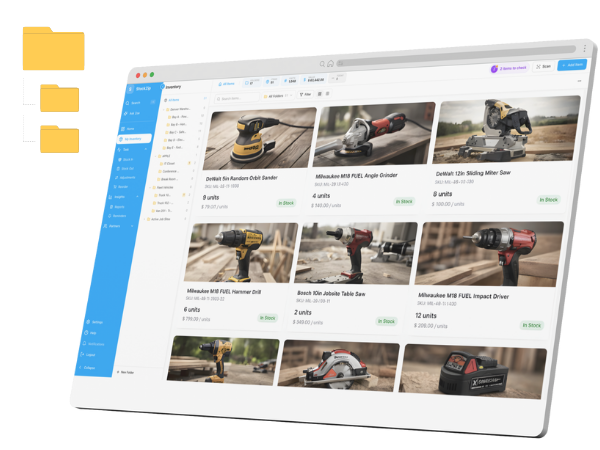
On that second path, StockZip is one option — but be clear about how it connects: StockZip does not integrate directly with Square, so there is no live sync between them; you would move data between the two by CSV import and export, not an automatic feed. StockZip is a standalone, scan-first system for exactly the inventory Square is weakest at — tools, equipment, assets, and stockroom items you count and move off the register — with barcode scanning, folders and locations, and check-in/check-out on paid plans. Used that way it complements Square rather than replacing it: Square keeps ringing up and tracking what you sell, and a separate tool handles the assets and back-of-house stock that never do.
Common questions about Square inventory
Can you manage inventory with Square? Yes — inventory tracking is built into the free Square Point of Sale app, so any business already taking payments with Square can track stock counts, receive and adjust inventory, and get low-stock alerts without paying for a separate tool. For deeper needs, Square for Retail adds purchase orders, cost tracking, and multi-location control on a paid plan.
What is the downside of using Square for inventory? The main limitation is scope: Square is built to track the items you sell through the register, so it is a weaker fit for inventory that never rings up — tools, equipment, raw materials, and assets you own and reuse. Its deepest purchasing and reporting features also sit on the paid Square for Retail tier rather than the free plan, and off-the-register standalone scanning is not its focus.
Does Square track inventory across multiple locations? Yes, but on the paid Square for Retail plan rather than the free tier. Retail keeps separate counts per location and lets you transfer stock between them, which is the right depth for a multi-store retailer. It manages how much is where and lets you move it; it does not run deep warehouse logistics like bin locations and pick paths, which is where a dedicated warehouse system would come in.
The bottom line
Square inventory management is a strong, free starting point for any business whose stock is what it sells, and Square for Retail is a credible full inventory tool for growing multi-location shops. If that describes you, Square may be all you ever need, and the right first step is simply to turn its tools on and set your counts carefully.
The time to look further is when your inventory stops matching Square’s assumption — when you are tracking assets and equipment that never sell, when you need standalone scanning away from the register, or when your back-of-house stock deserves its own system. Then either sync a dedicated app through Square’s API, or run a separate scan-first tool alongside it and move data by CSV. Match the tool to where your inventory actually lives, and you will not overpay for capability you do not use or force stock through a register it was never meant to touch.