
A bill of materials, or BOM, is the list of components, quantities, and instructions needed to build, assemble, repair, or package a finished item.
What a bill of materials includes
A BOM usually includes the finished item, component names, SKUs, quantities, units of measure, optional substitutes, notes, and sometimes labor or assembly steps.
Why BOMs matter
A BOM prevents teams from guessing what parts are needed. It improves purchasing, reduces missing components, and helps estimate whether enough stock exists to build or repair something.
Types of bills of materials
BOMs come in a few common forms, and knowing the difference helps you keep yours at the right level of detail.
• Single-level BOM: a flat list of components for a simple product or one-stage assembly — best for kits and bundles.
• Multi-level (indented) BOM: shows sub-assemblies nested inside the finished item, for products built in stages.
• Engineering BOM (EBOM): reflects design intent, often mirroring a CAD drawing; used in product design.
• Manufacturing BOM (MBOM): the production-ready version — real part numbers, substitutes, and packaging — that a build actually consumes.
Simple BOM example
A field repair kit is a clear single-level BOM. The finished item is the kit; the components and quantities might read:
Finished item: Fiber field repair kit (1 unit). Components: case ×1, connectors ×2, patch cable ×1, label ×1, printed instruction card ×1. Each component should have its own inventory record, SKU, unit of measure, and reorder point so the kit can be assembled on demand.
How a BOM connects to reordering (the MRP link)
In larger systems, material requirements planning (MRP) "explodes" a BOM: it multiplies each component by how many finished items you plan to build, subtracts what you already have, and factors in supplier lead time and safety stock to suggest what to purchase and when.
You do not need full MRP software to use the idea. If you know a build needs two connectors per kit and you plan ten kits, you need twenty connectors on hand — set component reorder points with that math in mind so a single missing part never stalls an assembly.
How inventory software supports BOM workflows
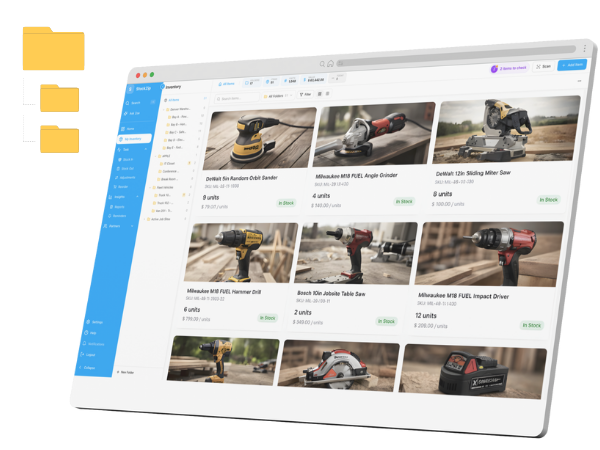
Inventory software helps by tracking component availability, receiving parts, counting stock, and alerting when a component falls below reorder point. StockZip tracks component inventory, locations, reorder points, and movement history; full multi-level manufacturing BOM planning and work orders are better served by dedicated MRP software.
What does BOM stand for?
BOM stands for bill of materials.
Is a BOM only for manufacturers?
No. Small businesses use BOMs for kits, repairs, installations, bundles, and repeatable service packages.
What is the difference between a BOM and inventory list?
An inventory list shows what you have. A BOM shows what is needed to build, assemble, or complete something.
Can StockZip manage BOMs?
StockZip tracks component inventory, locations, reorder points, and movement history. More advanced manufacturing BOM planning may require dedicated manufacturing software.
What are the main types of BOM?
The common types are single-level (a flat component list for simple kits), multi-level or indented (sub-assemblies nested inside the finished item), engineering BOM (EBOM, design intent), and manufacturing BOM (MBOM, the production-ready version a build consumes).