Kitting
Kitting is the inventory process of combining multiple individual SKUs into a single, pre-packaged unit that ships as one item.
What it means
In practical terms, kitting means you take items A, B, C, and D out of regular stock, pack them together, and create a new parent SKU — call it KIT-001. From that moment, KIT-001 is what your warehouse picks, your shipping label points at, and your customer receives.
Example: a coffee subscription box. The components are one 250g bag of beans (SKU BEAN-ETH), one branded mug (SKU MUG-WH), one recipe card (SKU CARD-01), and a kraft box (SKU BOX-M). On its own, none of that ships. As KIT-COFFEE-MAR, it ships 1,200 times in March. You decrement four child SKUs and one box per kit built.
Kitting vs assembly vs BOM
People mix these up constantly, so here's the clean line.
A bill of materials (BOM) is a list. It says "to make one finished product, you need these parts in these quantities." It's a document.
Assembly is what manufacturing does with a BOM — taking raw materials, applying labor, and producing something materially different. A bicycle frame plus wheels plus a chain becomes a bicycle. The output isn't reversible without tools.
Kitting sits between the two. You're following something that looks like a BOM, but you're not transforming the items. You're just grouping them. Tear the shrink wrap off a hardware kit and you've got the same screws, brackets, and washers you started with.
That distinction matters for accounting. Assembled goods often need labor and overhead in their cost. Kits usually just roll up component cost plus packaging. Many bill of materials systems support both — flag the parent as a kit vs a manufactured item so cost rolls up correctly.
Pre-kit vs on-demand kitting
You've got two choices on timing.
Pre-kitting means you build the kits up front and stock them as finished goods. Good when demand is predictable, components are stable, and pick speed matters. A subscription box company pre-kits the entire month's run on the 25th.
On-demand kitting (sometimes called pick-to-order kitting) means you assemble the kit only when an order lands. Good when components are expensive, demand is lumpy, or customers personalize the contents. A B2B promo company kitting branded swag for a specific client event does it on demand.
The tradeoff is obvious. Pre-kitting locks inventory into a parent SKU you might not sell. On-demand kitting adds 30–90 seconds to every order pick. Most operations end up doing both — pre-kit your top sellers, build the long tail on demand.
Common kitting examples
• Subscription boxes — meal kits, beauty boxes, coffee samplers. The whole business model is kitting.
• Gift baskets — wine + cheese + crackers + ribbon in a wicker basket. Holiday spikes make pre-kitting essential.
• Hardware kits — a "shed install kit" with 24 screws, 4 hinges, 2 brackets, and an instruction sheet. Sold as one SKU, picked as one SKU.
• Medical procedure trays — sterile single-use kits with gauze, syringe, gloves, scalpel. Lot-tracked and expiry-tracked at the component level.
• Promotional swag packs — t-shirt + sticker + notebook for a new hire or trade show booth.
Kitting pitfalls
Three traps catch most teams.
Over-committing components. Pre-kit too aggressively and you've buried a component SKU inside a parent that isn't moving. If MUG-WH is also sold solo, every mug locked in KIT-COFFEE-MAR is one you can't sell on its own.
Demand misforecast. Build 2,000 kits, sell 800, and you've got 1,200 units of finished goods that need un-kitting. That's labor you didn't plan for.
Traceability gaps. When a component gets recalled — a contaminated ingredient, a defective part — you need to know which kits it ended up in. If your system tracks the kit as one opaque SKU and forgets the components, the recall blows up. Make sure your inventory tool keeps component lot/serial visibility on every kit built.
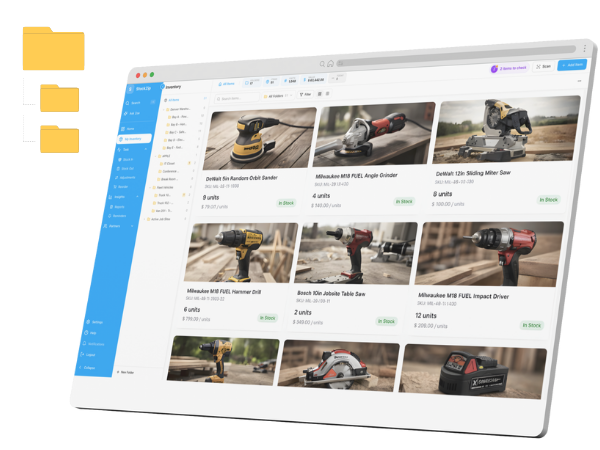
Track it in StockZip
StockZip handles kit parent SKUs with component decrement built in — build a kit and the child SKUs drop automatically.
Frequently asked questions
Is kitting the same as a BOM?
No. A BOM is the recipe; kitting is the act of grouping items per that recipe. A kit usually has a BOM behind it, but a BOM by itself doesn't mean you're kitting — it might be feeding a full assembly process instead.
What's the difference between pre-kitting and on-demand kitting?
Pre-kitting builds the bundle in advance and stocks it as a finished SKU. On-demand kitting builds the bundle only when an order comes in. Pre-kitting is faster at pick time; on-demand keeps components flexible.
When does kitting make sense?
When the same combination of items ships repeatedly, when picking the components individually is slow, or when you want a single SKU your sales channels can list. If a bundle ships fewer than a few times a month, skip the kit and let pickers grab the components.
Can I kit perishable items?
Yes, but expiry tracking gets harder. The kit's effective expiry is whichever component expires first. If you pre-kit perishables, build smaller batches and rotate aggressively — FEFO (first-expired-first-out) discipline matters more than ever.