
Cross-Docking
Cross-docking is a logistics practice where inbound goods are transferred directly from receiving to outbound shipping with little or no storage in between.
What it means
In a traditional warehouse, an inbound shipment gets received, putaway, stored, picked, packed, and shipped. That's five touches. With cross-docking, an inbound shipment gets received, staged briefly at a dock door, and reloaded onto an outbound truck. Two touches, maybe three.
Example: a regional grocery distributor receives a truckload of bananas at 6 AM. By 9 AM, those same bananas are split across 14 outbound trucks heading to individual store locations. The bananas never get stored. They never get a putaway location. The facility is essentially a sorting node.
Cross-docking only works when three things line up — inbound timing, outbound demand, and dock capacity. Miss any one of them and product piles up on the floor, which is exactly what you were trying to avoid.
Pre-distribution vs post-distribution cross-docking
There are two flavors, and the difference comes down to when you decide where the product is going.
Pre-distribution cross-docking means the supplier ships product already labeled and sorted for the final destination. The pallet leaves the manufacturer addressed to "Store 042" or "Customer Lee." Your facility just moves it from inbound dock to outbound dock. This is the cleanest version, but it requires tight supplier coordination — the vendor needs to know your downstream demand before they pack.
Post-distribution cross-docking means product arrives in bulk and your facility decides where it goes. You break a 40-pallet inbound load into 12 outbound trucks based on whatever orders are open that morning. More flexible, but it puts the sorting work on you. You need a system that can match inbound receipts to outbound orders in near real time.
Most operations end up with a hybrid. Top SKUs from reliable vendors come pre-sorted. Long-tail SKUs get the post-distribution treatment.
Pros and cons
Pros:
• Less holding cost — no rent, no insurance, no shrink on stored inventory.
• Faster cycle time — customer gets product days earlier.
• Lower labor cost per unit — fewer touches means fewer pick/pack hours.
• Less warehouse footprint required — cross-dock facilities are mostly dock doors and floor space, not racking.
• Less risk of obsolescence on perishables.
Cons:
• Demands tight scheduling — a late inbound truck cascades into late outbound trucks.
• High dependency on vendor reliability — if a supplier ships short or late, downstream customers feel it immediately.
• Limited buffer — there's no safety stock to absorb a demand spike.
• Tech investment — WMS, real-time tracking, and dock scheduling systems aren't optional.
• Hard to do for slow-moving or unpredictable SKUs.
When cross-docking makes sense
Three patterns where it pays off.
Perishables. Bananas, dairy, cut flowers, prepared meals. The longer they sit, the worse they get. Cross-docking compresses time-in-facility from days to hours.
E-commerce same-day or next-day fulfillment. When the customer expects delivery tomorrow, you don't have time for a putaway-and-pick cycle. Major e-commerce networks pre-sort at the origin and cross-dock at the regional node.
Hub-and-spoke retail. A retailer with 200 stores doesn't need to stockpile inventory at the central DC. The DC receives, sorts, and dispatches the same day. Walmart famously built a chunk of its 1990s cost advantage on exactly this pattern.
It does NOT make sense for: low-volume SKUs, irregular demand, suppliers with poor on-time-in-full performance, or operations that lack the dock scheduling discipline to handle synchronized inbound/outbound flow.
Real example
A meal-kit company receives 14 inbound trucks each Monday from produce, protein, and dry-goods suppliers. By Tuesday afternoon, those inputs are sorted into customer-specific bags and loaded onto 22 outbound delivery trucks. Total time at the facility: under 18 hours per item, against a shelf-life clock of 5–7 days. Without cross-docking, they'd need 4–5× the cold storage square footage and would write off significantly more product to spoilage.
Track it in StockZip
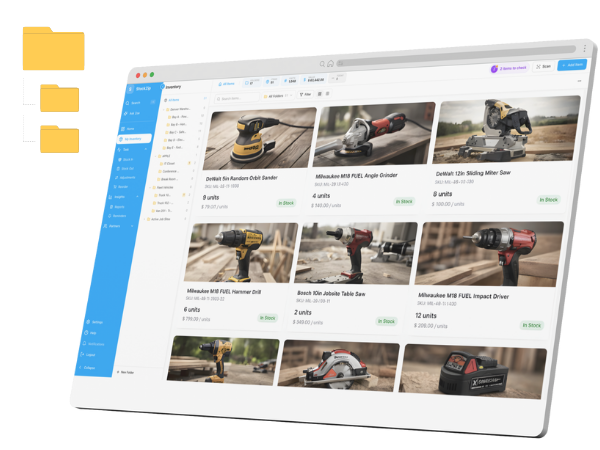
If your inbound and outbound timing is tight, you need warehouse inventory software that ties receiving directly to open orders. StockZip flags inbound items already committed to outbound orders so they bypass putaway.
Frequently asked questions
How is cross-docking different from drop-shipping?
In drop-shipping, product never touches your facility at all — it ships directly from supplier to end customer. In cross-docking, product touches your facility, just briefly. You sort, consolidate, and re-route, but you don’t store.
Do I need a special facility?
Helpful but not strictly required. A purpose-built cross-dock facility has many dock doors on opposite sides of a long, narrow building (an "I" or "T" layout) and minimal racking. You can cross-dock from a conventional warehouse, but you’ll be working around the storage racks.
What industries use cross-docking most?
Grocery, retail, e-commerce fulfillment, auto parts distribution, mail and parcel services. Anywhere that ships high volumes of time-sensitive goods through regional hubs.
Can a small business use cross-docking?
Yes, in a lightweight form. If you receive a vendor shipment on Tuesday morning and it’s already packed in customer-specific bundles, you can stage it and re-ship without ever putting it on a shelf. The principle scales down — what changes is how much process and software you need around it.