

Purchase Requisition
A purchase requisition is an internal document used by an employee to request the purchase of goods or services, which is reviewed and approved before a purchase order is sent to a supplier.
What it means
Think of a requisition as the "I'd like to spend money on this" message, and the purchase order as the "we agreed, please ship it" message. The first is an internal control. The second is a legal commitment to a third party.
A simple example. A warehouse supervisor at a 30-person company runs low on packing tape. She opens an internal form, enters: "100 cases of 2-inch clear tape, vendor X, $480, needed by Friday." Her manager approves it. Finance confirms there's budget. The system generates a PO, emails it to vendor X, and the tape ships. If anyone later asks "why did we spend $480 on tape?" — the requisition shows who asked, who approved, and against which budget line.
Without the requisition step, anyone with a corporate card can buy anything, and finance finds out at the end of the month. With it, every spend has a paper trail.
Purchase requisition vs purchase order
The clearest way to keep them straight:
• | Purchase Requisition (PR) | Purchase Order (PO)
• Audience | Internal — your approvers | External — the supplier
• Purpose | Request approval to spend | Place a legally binding order
• Comes first? | Yes | No, PO follows the approved PR
• Legally binding? | No | Yes, once accepted by the supplier
• Includes vendor terms? | Often optional | Always
• Who writes it? | The requester (anyone) | Procurement / buyer
• Status flow | Submitted → Approved/Rejected | Sent → Acknowledged → Received → Closed
A PR can be rejected; a PO usually can't be cancelled without a fee. That's the practical reason the requisition step exists — it's your last chance to say no for free.
The 5-step approval workflow
The standard PR workflow at most companies looks like this:
• Submit. The requester fills out the form: item, quantity, suggested vendor, estimated cost, GL account, needed-by date, justification.
• Department review. The requester's manager checks that the spend makes sense for the team — right vendor, reasonable quantity, not duplicate of an existing item in stock.
• Budget check. Finance (or the system) verifies there's budget on the right GL line for the current period. If not, the PR bounces back with a note.
• Procurement review. The buyer checks the vendor (preferred supplier list, payment terms, MOQ, lead time) and may swap the vendor, adjust quantity, or consolidate with other open PRs.
• Convert to PO. Once all approvals are in, the PR is converted to a PO and sent to the supplier. The PR number stays linked to the PO for audit.
Smaller companies collapse this to two or three steps. Larger ones split step 2 into multiple manager levels based on dollar thresholds (e.g., supervisor approves up to $1,000, director up to $25,000, VP above).
Required fields on a purchase requisition
A usable requisition form has these fields. Cut anything not on the list — extra fields just slow people down:
• Requester name and department
• Date submitted and needed-by date
• Item description — SKU if internal, vendor part number if not
• Quantity and unit of measure
• Estimated unit price and total
• Suggested vendor (optional — procurement may override)
• GL account / cost center the spend hits
• Business justification — one or two sentences
• Delivery location (which warehouse, which dock)
• Attachments — vendor quote, BOM, prior PO reference
That's a complete PR in about 11 fields. Anything beyond that is either company-specific compliance (project codes, capital vs expense flag) or noise.
When to skip purchase requisitions
Requisitions are friction. They're worth it when the spend is large, recurring, or auditable. They're overhead when the spend is tiny and the requester is trusted.
You can reasonably skip PRs for:
• Petty cash or P-card purchases under a threshold (e.g., under $250). Run these on monthly expense reports instead.
• Pre-approved consumables on standing orders. If you ship 500 boxes a month from one vendor, set up a blanket PO and skip the per-order requisition.
• Emergency repairs where downtime cost exceeds the value of the control. Add a post-hoc approval review instead.
• Subscriptions and recurring services that have already been approved once.
A two-person company has no business running purchase requisitions. A 200-person company has no business not running them. The transition usually happens around 15–25 employees, when "I'll just ask the founder" stops scaling.
Track it in StockZip
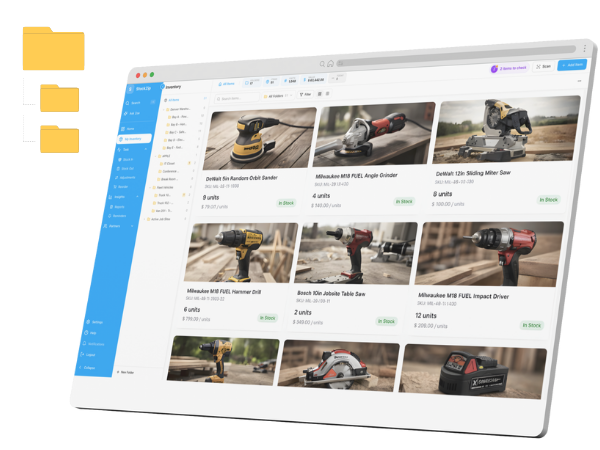
StockZip lets you raise a requisition from a low-stock alert, route it to the right approver, and convert it to a PO in one click — with the original requester, approver, and timestamp on the audit trail forever.
Frequently asked questions
Is a purchase requisition the same as a purchase order?
No. A requisition is internal — it's how an employee asks permission to buy something. A purchase order is external — it's the document sent to the supplier once the requisition is approved. The requisition always comes first.
Who can submit a purchase requisition?
Usually any employee who needs goods or services, though companies often restrict who can submit which categories. A warehouse picker might be able to requisition packing supplies; only an IT lead can requisition servers. The approval routing handles the gatekeeping.
What fields are required on a requisition?
At minimum: requester, date, item description, quantity, estimated cost, GL account, suggested vendor, needed-by date, and a one-line justification. Anything beyond that is company-specific compliance, not a baseline requirement.
Do small businesses need requisitions?
Under about 15 employees, no — direct approval is faster. Between 15 and 50, a lightweight PR (a simple form, one approver, email approvals) starts paying for itself in budget control and audit trail. Above 50, formal PRs are essentially required.